Jennifer McClure`

Equipping people leaders to navigate change — and design the future — with boldness and purpose.

  • About
  • Speaking
  • Schedule
  • Blog
  • Impact Makers Podcast
  • Contact

Written by Jennifer McClure

Why HR Should Be the Chief Disruption Officer in Every Organization

Imagine a world where HR isn’t just a support function, but a catalyst for innovation — driving agility and transformation. A world where HR leaders are not thought of as the policy police, but as visionaries, shaping the future of work.

When I started my career in HR nearly four decades ago, I fully believed that HR was the most important place to work in any organization, because the work that we do impacts every employee in the organization. I still believe that.

However, we’re in unique and challenging times, my friends.

We live in a world of unprecedented change. Increased globalization, shifting employee expectations, technology disruptions, and rising employee burnout rates present significant challenges.

But, these challenges also open doors to pathways for innovation and growth, and HR is the key to any successful business transformation.

Are you ready to seize this opportunity?

I believe that HR is uniquely positioned to lead this transformation, and I want to challenge you to embrace the role of Chief Disruption Officer in your organization and take the lead in shaping a bold new future of work.

Why HR?

Because people are at the heart of every business challenge and opportunity that lies ahead. They’re both the source of every problem and every solution, and WE are the people experts in our organizations — or at least we should be.

Challenges and Opportunities Lie Ahead

Recent studies have shown that CEOs and senior executives know that talent drives innovation and growth. And in a knowledge economy, people are truly the biggest source of competitive advantage in any organization.

But, due to changing employee expectations, it’s now more important than ever to create and nurture workplace cultures that foster employee engagement, loyalty, and high performance to ensure long-term success.

Also, according to Randstad’s 2024 Talent Trends Research, 72% of business leaders — the highest level since 2019 — are worried about the growing skills gap, which is expected to widen as digital transformation accelerates. They know that they need a workforce equipped with future-ready skills, or their organizations risk falling behind.

Finally, with economic uncertainty looming, organizations face pressures to optimize costs while still investing in talent development and retention. We must balance the need to attract and retain talent with the economic reality of doing more with less. To do this we’ll need to create more efficient, skills-based organizations that can operate effectively with a leaner, more agile workforce.

So what does the role of HR as the Chief Disruption Officer look like, and what steps can we take to get leaders in our organizations to view us as innovative leaders of positive change?

HR Leaders Must Radically Shift Their Mindset and Approach

Adopt a Strategic Mindset — Think Like a Business Leader, Not Just an HR Professional:

We’ve all heard this for years, but trust me, it’s still not a consistent practice. And we can’t get off the starting line on the journey of leading disruption until we understand how to align HR objectives with the broader business strategy.

To do this, we must speak the language of the C-suite (which is money), and focus on how HR initiatives drive revenue, improve efficiency, and boost competitive advantage. For example, don’t just report employee satisfaction scores, demonstrate how engagement initiatives boost productivity and directly impact the bottom line.

Challenging the Status Quo:

We must relentlessly question outdated practices and processes. If we’ve always done it this way — even if it’s working — it’s ripe for a review to see if we can do it differently in order to grow.

Innovation often starts with asking, “Can we do it better?”

Focus on Outcome-Oriented HR Initiatives:

We must focus on the outcomes of our HR initiatives, not the processes. This means prioritizing initiatives that directly impact business goals, which include talent strategies that drive innovation, reduce costs, or enhance customer satisfaction.

By demonstrating a clear link between HR activities and business success, we’ll become indispensable to the organization.

Foster an Innovative and Creative Company Culture:

To be seen as an innovative leader, HR must take the lead in fostering a culture of creativity and innovation within the organization. This means we should encourage risk-taking, support new ideas, and create an environment where continuous learning and development are prioritized. And HR should lead by example, adopting innovative HR technologies and practices that streamline processes and enhance employee experience.

Lead Change Management Efforts:

HR Leaders must position themselves as drivers of change within their organizations — especially during times of transformation — by leading initiatives around digital transformation, organizational restructuring, and cultural change.

To lead disruption and transformation efforts, we must become experts in change management and demonstrate our ability to lead the organization through complex transitions.

Embrace Digital Transformation:

First, we must embrace digital transformation within HR itself. This includes using AI-driven tools to enhance efficiency and improve decision-making.

HR should be leading the charge to prepare our workforces for digital transformation by promoting a growth mindset, fostering a culture that embraces change and innovation, and creating pathways to help develop new skills that will be necessary for the future of work.

Anticipating Future Trends:

We must be relentlessly curious and interested in what’s happening in the world today, and also where trends are headed.

To lead in the future of work, HR leaders must anticipate and stay ahead of emerging trends and technologies.

Human Resources: The Most Important Place to Work In Any Organization

While the benefits of HR as the Chief Disruption Officer are clear, some may argue that HR lacks the necessary business acumen or authority to drive such transformative change. However, by developing strong relationships with the C-Suite, demonstrating a deep understanding of business objectives, and delivering tangible results, HR can gain the trust and support necessary to lead.

I strongly believe that HR is not just a support function; it’s uniquely positioned to drive transformative change and ensure the long-term success of our organizations.

But to do this, we must move beyond traditional HR roles, and become proactive disruptors who challenge outdated practices and implement forward-thinking strategies.

The future of work is waiting for a Disruptor. Are you ready to step up?


As a keynote speaker and leadership coach, Jennifer McClure helps leaders to embrace the future of work, and to develop the skills necessary to lead their organizations and the people on their teams to take bold actions that positively impact business results.

Want more leadership and future of work insights from me?

SUBSCRIBE to get my weekly Impact Makers newsletter delivered to your inbox!

Categories: Blog, Human Resources, Leadership
Posted on September 17, 2024

Written by Jennifer McClure

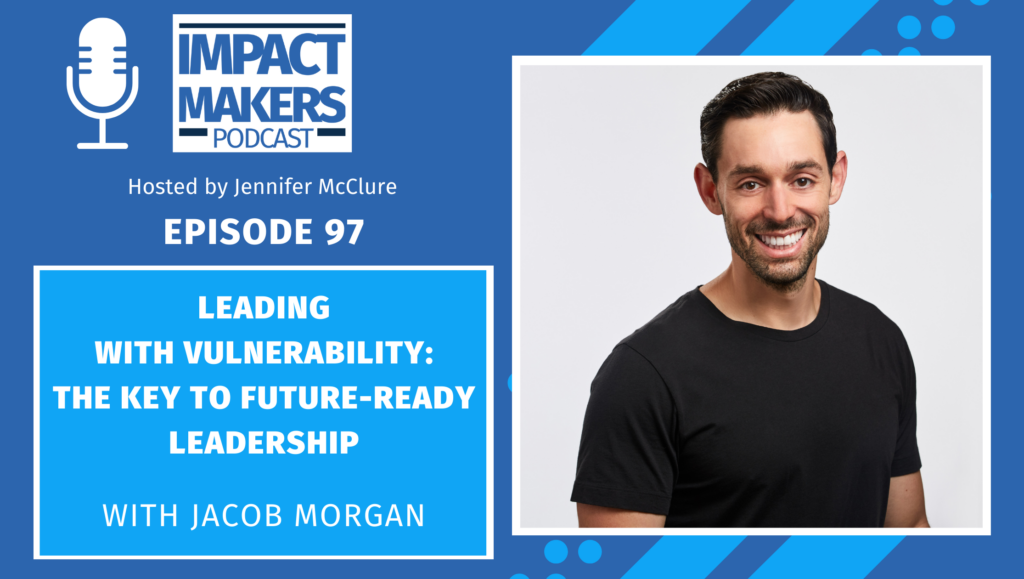
Leading with Vulnerability: The Key to Future-Ready Leadership with Jacob Morgan

What happens when a leader unveils their vulnerability? Does it weaken their status or lead to a more profound connection with their team?

These intriguing questions are the foundation of my conversation with Jacob Morgan, a trained futurist and renowned authority on the future of work, leadership, and employee experience. We navigate through the complexities of leading with vulnerability, drawing from Jacob’s extensive research, real-world examples, and insights from his latest book, Lead with Vulnerability.

Think about the CEO who bares his soul about the struggles of the business, only to be fired, or the one who acknowledges the struggles but couples them with a clear vision leading to success. Stories like these help us to dissect the nuanced difference between vulnerability and leading with vulnerability, especially in a workplace setting. Jacob shares insights and practical advice on how leaders can incorporate vulnerability into their leadership style without undermining their competence.

What is the transformative power of vulnerability on employees? What happens when a CEO and COO embrace vulnerability amidst a company tragedy?

We dive deep into these questions, underscoring the significance of acknowledging one’s shortcomings and striving for improvement. Learn more about Jacob’s book, Lead with Vulnerability, and join us in this thought-provoking episode as we explore the future of work and elevate your understanding of leadership.

Topics Discussed In Today’s Episode:

  • The differences between being vulnerable at work and in your personal life.
  • Do leaders need to be more or less vulnerable than their employees?
  • Taking accountability and demonstrating growth
  • The important difference between leading with vulnerability, and being vulnerable.
  • The Vulnerable Leader Equation: leadership + vulnerability = leading with vulnerability.
  • The important characteristic that must be present in order for leading with vulnerability to be effective.
  • The Vulnerability Wheel – a framework that helps leaders assess when, what, and how to be vulnerable based on intention, timing, and other factors.
  • The eight attributes of vulnerable leaders.
  • Practical advice for leaders to start demonstrating vulnerability.

LISTEN TO IMPACT MAKERS PODCAST – EPISODE 97

Listen on Apple podcasts, Google podcasts or Spotify

People & Resources Mentioned In This Episode:

Jacob Morgan – Website, LinkedIn, Twitter, Instagram

Book: Leading with Vulnerability: Unlock Your Greatest Superpower to Transform Yourself, Your Team, and Your Organization by Jacob Morgan

Substack: Great Leadership With Jacob Morgan

Categories: Leadership, Podcast
Posted on January 4, 2024

Written by Jennifer McClure

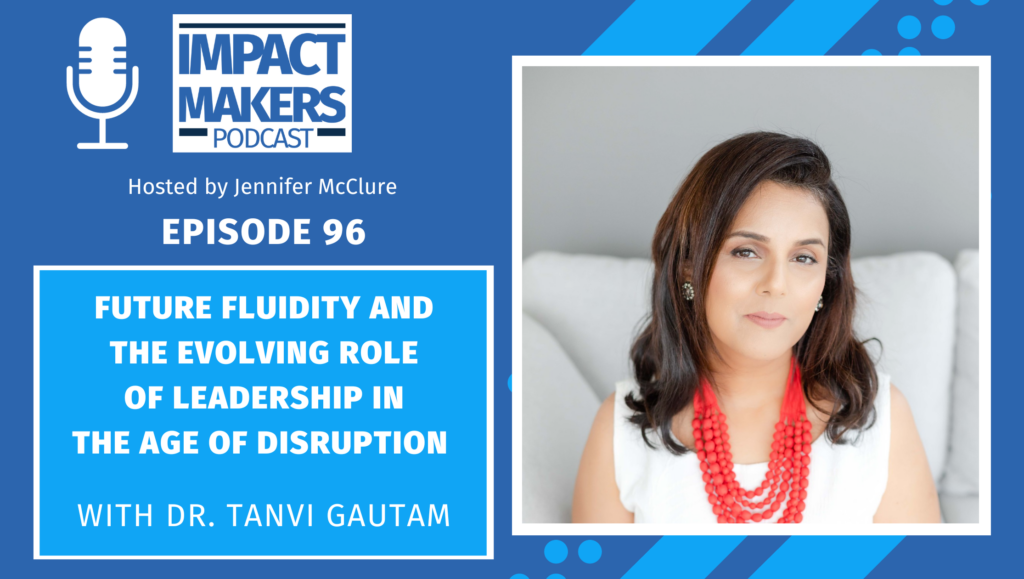
Future Fluidity and the Evolving Role of Leadership in the Age of Disruption With Dr. Tanvi Gautam

On episode 96 of the Impact Makers podcast, I welcome Dr. Tanvi Gautam, a world-renowned leadership development expert.

Dr. Gautam is a multi-award-winning keynote speaker, executive coach, author, and senior faculty and program director at Singapore Management University. She uses a combination of head and heart-based tools for upgrading leaders and to create culture transformation in organizations.

As we navigate a world rocked by global disruption, Dr. Gautam highlights how leadership is evolving and why it’s critical to adopt new tools and resources. She also shares her insights on the essence of true leadership, the essential leadership skills required in the age of disruption, and the intriguing concept of ‘future fluidity’.

Dr. Gautam shares how to cultivate flexibility and resilience — essential tools for navigating an uncertain future, and we explore the role technology plays in enhancing visibility and influence.

Whether you’re an emerging leader or an established executive, I think you’ll learn quite a bit from this episode, and will leave with practical steps you can take to evolve your own leadership skills.

Topics Discussed In Today’s Episode:

  • The focus of Dr. Gautam’s work – creating unstoppable leaders who can help their companies upgrade in the new age of disruption.
  • 4 skills that all leaders must develop to succeed in the future of work.
  • Why the tools, resources, and mindsets that made leaders successful in the past, are not what will be needed in the emerging world.
  • How viewing disruption and being disrupted as an invitation to reimagine and reinvent can create possibilities versus getting stuck or falling behind.
  • But how has leadership changed in a post-pandemic world?
  • Why developing the skills of rest and recovery will be a competitive advantage for both leaders and organizations.
  • The concept of “future fluidity”, and how developing this skill can help leaders to successfully navigate change and uncertainty.
  • Dr. Gautam’s forthcoming book – Deep Collaboration – will explore the five crucial conversations leaders must have to enable collaboration across organizational silos and boundaries.

LISTEN TO IMPACT MAKERS PODCAST – EPISODE 96

Listen on Apple podcasts, Google podcasts or Spotify

People & Resources Mentioned In This episode:

Dr. Tanvi Gautam – Website, LinkedIn, Twitter

Book — The Spark Lies Within: And other secrets of women leading inspired and authentic lives by Dr. Tanvi Gautam

WorkLife with Adam Grant Podcast: The Science of Recharging on Weekends and Vacations

Categories: Blog, Leadership, Podcast
Posted on October 19, 2023

Written by Jennifer McClure

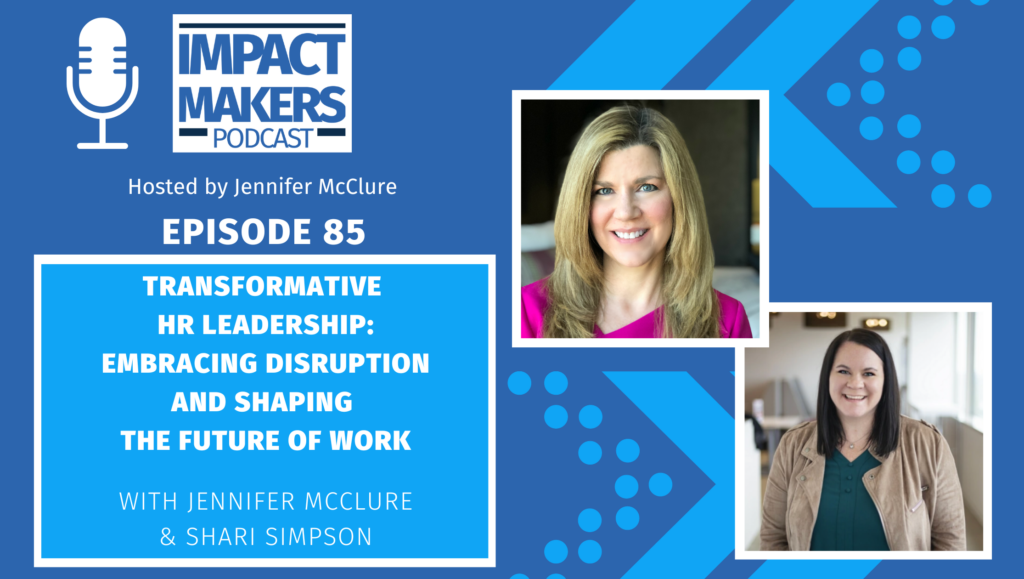
Transformative HR Leadership: Embracing Disruption and Shaping the Future of Work

On episode 85 of the Impact Makers podcast, I’m sharing a conversation with you that I had recently with Shari Simpson – Senior Manager of Thought Leadership at Paylocity – on the HR Mixtape podcast, which she hosts.

I asked Shari if I could also share the conversation with the Impact Makers community, because I thought she asked some great questions about the challenges and opportunities that HR leaders are facing in a world where work and employee expectations have changed forever.

We discussed how technology and artificial intelligence impacts HR, as well as how HR can lead in the future of work in the areas of attracting and retaining talent, redefining employee engagement, and connecting employees with meaning and purpose in their work. We also touched on how HR leaders can build their influence, and make a significant impact in their organizations as well as the broader HR community.

I’ve linked to the episode of the HR Mixtape podcast where this conversation originally appeared below. I encourage you to connect with Shari, and to follow or subscribe to the HR Mixtape podcast so you can listen to more thought-provoking interviews, compliance tips, coffee chats, and the latest HR-related news.

Topics Discussed In Today’s Episode:

  • Current and future challenges confronting HR leaders.
  • The crucial role of HR in adopting technology impacting the workplace.
  • The influence of consumer experience on employee satisfaction and competitiveness in the labor market.
  • Defining employee engagement and strategies for positive impact.
  • The significance of a learner’s mindset for HR leaders and methods to gain beneficial insights.
  • Guidance for HR leaders on enhancing their influence and contributing to meaningful conversations in their profession, company, and industry.

LISTEN TO IMPACT MAKERS PODCAST – EPISODE 85

Listen on Apple podcasts, Google podcasts or Spotify

People & Resources Mentioned In This Episode:

Shari Simpson – LinkedIn, Twitter, Instagram

HR Mixtape Podcast

HR Mixtape Podcast — HR Evolved: Navigating Challenges and Embracing the Future with Jennifer McClure

PCTY Talks Podcast — Creating Your Personal HR Brand with Jennifer McClure

Re:Thinking with Adam Grant — ChatGPT did NOT title this podcast (w/ Allie Miller & Ethan Mollick)

Impact Makers Podcast — Defining Return on Workforce Investment in the Future of Work with Dr. Alexander Alonso

Redefining Work Podcast with Lars Schmidt

Punk Rock HR Podcast with Laurie Ruettimann

Digital HR Leaders Podcast with David Green

Kris Dunn – The HR Capitalist

Noah Warder – LinkedIn

Tracie Sponenberg – LinkedIn

Julie Turney – LinkedIn

Subscribe to Jennifer McClure’s Impact Makers Newsletter

Categories: Blog, Employee Engagement, Future of Work, Human Resources, Podcast
Posted on July 27, 2023

Written by Jennifer McClure

10 Critical Focus Areas for Leadership Success in the Future of Work

Unlocking the full potential of your team and paving the way for success in the future of work requires strategic focus and deliberate action. As a leader, it’s crucial to prioritize key areas that will make a significant impact on your organization and its employees.

In the ever-changing world of work, where technology advancements, globalization, demographic shifts, and changing societal norms continue to reshape the way we live and work, where should you focus, in order to create the most impact in your organization, and in the lives of the people that you lead and serve?

10 Critical Focus Areas for Leadership Success in the Future of Work

1. Fight for flexibility for your team members

People want to effortlessly work how, where, when, and for whom they want.

  • 40% of respondents in McKinsey’s Great Attrition Great Attraction Survey published in September 2021, said that flexibility was the number one reason they accepted their current job.
  • According to Shiftboard’s State of the Hourly Worker Report scheduling is the #1 complaint of hourly workers and the #1 cause of turnover.
  • 85% of the hourly workers who participated in Shiftboard’s survey reported that scheduling affects their overall job satisfaction.
2. Prioritize career growth and development opportunities for your people

According to Gloat Research Group’s Great Resignation 2.0 Report, the number one reason given by employees who took a new job as to why they would leave again was a lack of career development opportunities.

The same survey revealed that 54% of the employees surveyed reported that their employers either don’t take their future interests and aspirations into consideration enough, or not at all.

3. Help your people to connect with Meaning and Purpose in their work

It’s critically important for leaders to connect people to something bigger than themselves and help them contribute.

According to Gallup research, a 10% improvement in employees’ connection with the Mission or Purpose of their organization leads to an 8.1% decrease in turnover and a 4.4% increase in profitability.

I love this quote from Laszlo Bock – the current CEO & Co-Founder of Humu and former Google SVP of People Operations:

The single biggest thing you can do [as a leader] is to make the work feel meaningful.

What is an organization’s Purpose? It’s the reason for its existence, and the ultimate goal it seeks to achieve for customers.

Some good examples of organizational Purpose include:

  • Nourishing families so they can flourish and thrive – Kellogg
  • We fulfill dreams of personal freedom – Harley Davidson
  • We help people get jobs – Indeed.com
4. Commit to real change and action with Diversity, Equity, Inclusion, and Belonging efforts

How can you begin to make DEI&B efforts more meaningful and real in your organization?

  • Set meaningful goals
  • Track progress
  • Hold leaders accountable
  • Incentivize leaders

To learn more about how to think and act strategically when it comes to DEI&B, check out  Impact Makers podcast Episode #51 – The Value of Taking a Strategic Approach to Diversity, Equity, and Inclusion with Jennifer Ingram (she, her, hers) – Founder and CEO of Calibrated Lens.

5. Invest in your leaders – specifically front-line supervisors

The biggest gains businesses will witness in the future will come from hiring and training the right managers, who care for, develop, and maximize the strengths of every single employee.

Per Gallup’s meta-analytics based upon 100 million employee interviews 70% of the variance between highest engaged teams and persistently disengaged teams is just the manager.

6. Focus on skills identification and development

I think this quote from Jonas Prising – Chairman & CEO of ManpowerGroup, sums up this critical focus area in future of work well:

Helping people to pre-skill, upskill and reskill for in-demand roles in this Skills Revolution remains the defining challenge of this decade.

It was important before the pandemic, and is even more critical now – to create a better workplace where everyone is able to unleash their full human potential and have a more equitable share of the prosperity.

To learn more about best practices related to internal mobility and career upskilling, check out Impact Makers podcast Episode #64: Creating Career Pathways to Unlock Opportunity for the Workforce of the Future with Matthew Daniel – Principal, Talent Strategy and Mobility at Guild Education.

7. SEE your people

What do I mean by “SEE” your people?  

  • Show Appreciation.
  • Give Recognition.
  • Value Differences.

According to the results of a SurveyMonkey / Bonusly Survey, 63% of employees who are regularly recognized were “very unlikely” to look for a job in the next 6 months, and 89% of employees who are rarely recognized are open to accepting a new job.

And according to McKinsey’s Great Attrition Great Attraction Survey, the number one reason why people left a job without another one in hand was uncaring leaders.

In addition to helping your people to feel more valued, being a caring leader for your people actually makes good business sense.

8. Grow yourself

Your growth and development is your own responsibility, not that of your company, or your your boss. Take ownership of your personal development by:

  • Setting goals, tracking your progress, and holding yourself accountable.
  • Challenging yourself to learn aspects of business and leadership that are not within your current responsibilities.

As my friend Laurie Ruettimann says in her best-selling book Betting on You: How to Put Yourself First and (Finally) Take Control of Your Career:

If you’re learning, you’re growing, and if you’re growing, you’re thriving.

9. Develop your influence

As a leader, your ability to influence others is a critical factor in your career growth and success.

How can you develop your influence?

  • Invest in relationships.
  • Build trust.
  • Share your ideas.

My friend Neil Morrison – Group HR Director at Severn Trent Water, shared the following quote in a blog post years ago, which continues to resonate with me, because it’s so true:

You don’t get influence through control. You get influence through other people’s positive experience of you. You get influence through people wanting you involved – not by telling them you have to be.

10. Embrace (and lead) disruption

Change is a constant, and will continue at a rapid pace in the future. As leaders, we need to stay curious, and seek out ways to lead change efforts, rather than being reactive, and being affected by changes in unknown ways.

For HR and People leaders in particular, change agility was identified as a key skill in the future of work by SHRM research.

You can learn more about what the future of work holds for HR and People Leaders in Impact Makers podcast Episode #63: Defining Return on Workforce Investment in the Future of Work with Alexander Alonso, PhD SHRM-SCP – Chief Knowledge Officer at SHRM.

—–

So there you have it!

My 10 suggestions for areas where I believe leaders who will create positive and meaningful impact in the future of work need to focus now. Hopefully, you’re already actively making progress in several of these areas, and only need to add a few to your actions plans. Or, if you’re just getting started, choose a couple of areas to focus on, and start taking action today.

Categories: Blog, Future of Work, Leadership
Posted on July 5, 2023

  • 1
  • 2
  • 3
  • 4
  • Next Page »

Recent Posts

  • Why HR Should Be the Chief Disruption Officer in Every Organization
  • Mastering the Art of Virtual Networking: 5 Steps to Build Powerful Connections Online
  • Networking for Introverts: Practical Strategies for Building Meaningful Connections with Greg Roche
  • Leading with Vulnerability: The Key to Future-Ready Leadership with Jacob Morgan
  • Future Fluidity and the Evolving Role of Leadership in the Age of Disruption With Dr. Tanvi Gautam

Categories

Archives

Need A Speaker?

I've delivered keynotes and led workshops at over 350 conferences and corporate events.

If you want to check my availability for your event, or if you have questions, click below.

Start the Conversation »

Recent Blog Posts

  • Why HR Should Be the Chief Disruption Officer in Every Organization
  • Mastering the Art of Virtual Networking: 5 Steps to Build Powerful Connections Online
  • Networking for Introverts: Practical Strategies for Building Meaningful Connections with Greg Roche
  • Leading with Vulnerability: The Key to Future-Ready Leadership with Jacob Morgan
  • Future Fluidity and the Evolving Role of Leadership in the Age of Disruption With Dr. Tanvi Gautam

Connect on Social

  • Facebook
  • Instagram
  • LinkedIn
  • Twitter
  • Vimeo

Copyright © 2026 · Jennifer McClure · Privacy Policy

Copyright © 2026 · McClure Pro on Genesis Framework · WordPress · Log in