Jennifer McClure`

Equipping people leaders to navigate change — and design the future — with boldness and purpose.

  • About
  • Speaking
  • Schedule
  • Blog
  • Impact Makers Podcast
  • Contact

Written by Jennifer McClure

Why HR Should Be the Chief Disruption Officer in Every Organization

Imagine a world where HR isn’t just a support function, but a catalyst for innovation — driving agility and transformation. A world where HR leaders are not thought of as the policy police, but as visionaries, shaping the future of work.

When I started my career in HR nearly four decades ago, I fully believed that HR was the most important place to work in any organization, because the work that we do impacts every employee in the organization. I still believe that.

However, we’re in unique and challenging times, my friends.

We live in a world of unprecedented change. Increased globalization, shifting employee expectations, technology disruptions, and rising employee burnout rates present significant challenges.

But, these challenges also open doors to pathways for innovation and growth, and HR is the key to any successful business transformation.

Are you ready to seize this opportunity?

I believe that HR is uniquely positioned to lead this transformation, and I want to challenge you to embrace the role of Chief Disruption Officer in your organization and take the lead in shaping a bold new future of work.

Why HR?

Because people are at the heart of every business challenge and opportunity that lies ahead. They’re both the source of every problem and every solution, and WE are the people experts in our organizations — or at least we should be.

Challenges and Opportunities Lie Ahead

Recent studies have shown that CEOs and senior executives know that talent drives innovation and growth. And in a knowledge economy, people are truly the biggest source of competitive advantage in any organization.

But, due to changing employee expectations, it’s now more important than ever to create and nurture workplace cultures that foster employee engagement, loyalty, and high performance to ensure long-term success.

Also, according to Randstad’s 2024 Talent Trends Research, 72% of business leaders — the highest level since 2019 — are worried about the growing skills gap, which is expected to widen as digital transformation accelerates. They know that they need a workforce equipped with future-ready skills, or their organizations risk falling behind.

Finally, with economic uncertainty looming, organizations face pressures to optimize costs while still investing in talent development and retention. We must balance the need to attract and retain talent with the economic reality of doing more with less. To do this we’ll need to create more efficient, skills-based organizations that can operate effectively with a leaner, more agile workforce.

So what does the role of HR as the Chief Disruption Officer look like, and what steps can we take to get leaders in our organizations to view us as innovative leaders of positive change?

HR Leaders Must Radically Shift Their Mindset and Approach

Adopt a Strategic Mindset — Think Like a Business Leader, Not Just an HR Professional:

We’ve all heard this for years, but trust me, it’s still not a consistent practice. And we can’t get off the starting line on the journey of leading disruption until we understand how to align HR objectives with the broader business strategy.

To do this, we must speak the language of the C-suite (which is money), and focus on how HR initiatives drive revenue, improve efficiency, and boost competitive advantage. For example, don’t just report employee satisfaction scores, demonstrate how engagement initiatives boost productivity and directly impact the bottom line.

Challenging the Status Quo:

We must relentlessly question outdated practices and processes. If we’ve always done it this way — even if it’s working — it’s ripe for a review to see if we can do it differently in order to grow.

Innovation often starts with asking, “Can we do it better?”

Focus on Outcome-Oriented HR Initiatives:

We must focus on the outcomes of our HR initiatives, not the processes. This means prioritizing initiatives that directly impact business goals, which include talent strategies that drive innovation, reduce costs, or enhance customer satisfaction.

By demonstrating a clear link between HR activities and business success, we’ll become indispensable to the organization.

Foster an Innovative and Creative Company Culture:

To be seen as an innovative leader, HR must take the lead in fostering a culture of creativity and innovation within the organization. This means we should encourage risk-taking, support new ideas, and create an environment where continuous learning and development are prioritized. And HR should lead by example, adopting innovative HR technologies and practices that streamline processes and enhance employee experience.

Lead Change Management Efforts:

HR Leaders must position themselves as drivers of change within their organizations — especially during times of transformation — by leading initiatives around digital transformation, organizational restructuring, and cultural change.

To lead disruption and transformation efforts, we must become experts in change management and demonstrate our ability to lead the organization through complex transitions.

Embrace Digital Transformation:

First, we must embrace digital transformation within HR itself. This includes using AI-driven tools to enhance efficiency and improve decision-making.

HR should be leading the charge to prepare our workforces for digital transformation by promoting a growth mindset, fostering a culture that embraces change and innovation, and creating pathways to help develop new skills that will be necessary for the future of work.

Anticipating Future Trends:

We must be relentlessly curious and interested in what’s happening in the world today, and also where trends are headed.

To lead in the future of work, HR leaders must anticipate and stay ahead of emerging trends and technologies.

Human Resources: The Most Important Place to Work In Any Organization

While the benefits of HR as the Chief Disruption Officer are clear, some may argue that HR lacks the necessary business acumen or authority to drive such transformative change. However, by developing strong relationships with the C-Suite, demonstrating a deep understanding of business objectives, and delivering tangible results, HR can gain the trust and support necessary to lead.

I strongly believe that HR is not just a support function; it’s uniquely positioned to drive transformative change and ensure the long-term success of our organizations.

But to do this, we must move beyond traditional HR roles, and become proactive disruptors who challenge outdated practices and implement forward-thinking strategies.

The future of work is waiting for a Disruptor. Are you ready to step up?


As a keynote speaker and leadership coach, Jennifer McClure helps leaders to embrace the future of work, and to develop the skills necessary to lead their organizations and the people on their teams to take bold actions that positively impact business results.

Want more leadership and future of work insights from me?

SUBSCRIBE to get my weekly Impact Makers newsletter delivered to your inbox!

Categories: Blog, Human Resources, Leadership
Posted on September 17, 2024

Written by Jennifer McClure

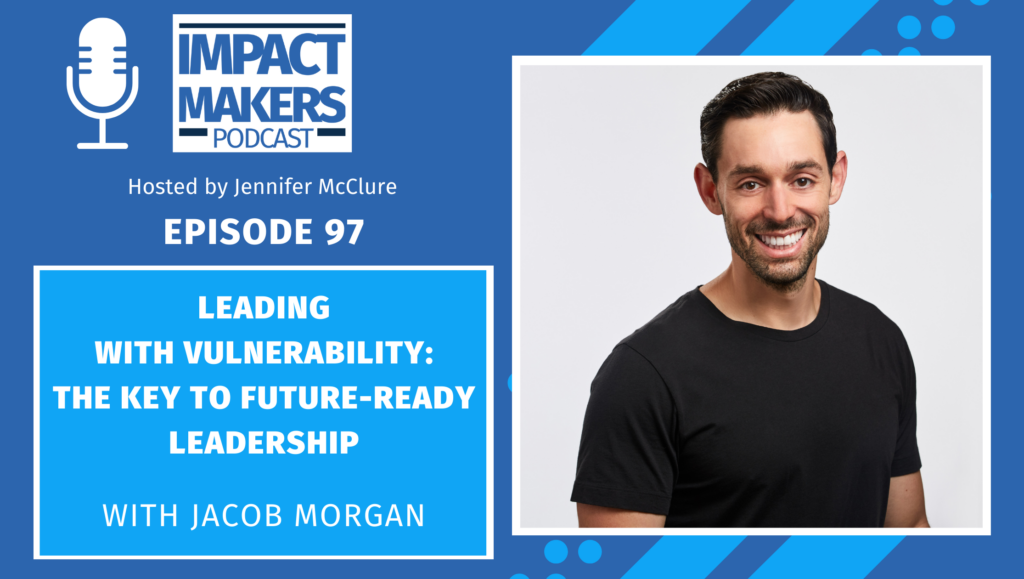
Leading with Vulnerability: The Key to Future-Ready Leadership with Jacob Morgan

What happens when a leader unveils their vulnerability? Does it weaken their status or lead to a more profound connection with their team?

These intriguing questions are the foundation of my conversation with Jacob Morgan, a trained futurist and renowned authority on the future of work, leadership, and employee experience. We navigate through the complexities of leading with vulnerability, drawing from Jacob’s extensive research, real-world examples, and insights from his latest book, Lead with Vulnerability.

Think about the CEO who bares his soul about the struggles of the business, only to be fired, or the one who acknowledges the struggles but couples them with a clear vision leading to success. Stories like these help us to dissect the nuanced difference between vulnerability and leading with vulnerability, especially in a workplace setting. Jacob shares insights and practical advice on how leaders can incorporate vulnerability into their leadership style without undermining their competence.

What is the transformative power of vulnerability on employees? What happens when a CEO and COO embrace vulnerability amidst a company tragedy?

We dive deep into these questions, underscoring the significance of acknowledging one’s shortcomings and striving for improvement. Learn more about Jacob’s book, Lead with Vulnerability, and join us in this thought-provoking episode as we explore the future of work and elevate your understanding of leadership.

Topics Discussed In Today’s Episode:

  • The differences between being vulnerable at work and in your personal life.
  • Do leaders need to be more or less vulnerable than their employees?
  • Taking accountability and demonstrating growth
  • The important difference between leading with vulnerability, and being vulnerable.
  • The Vulnerable Leader Equation: leadership + vulnerability = leading with vulnerability.
  • The important characteristic that must be present in order for leading with vulnerability to be effective.
  • The Vulnerability Wheel – a framework that helps leaders assess when, what, and how to be vulnerable based on intention, timing, and other factors.
  • The eight attributes of vulnerable leaders.
  • Practical advice for leaders to start demonstrating vulnerability.

LISTEN TO IMPACT MAKERS PODCAST – EPISODE 97

Listen on Apple podcasts, Google podcasts or Spotify

People & Resources Mentioned In This Episode:

Jacob Morgan – Website, LinkedIn, Twitter, Instagram

Book: Leading with Vulnerability: Unlock Your Greatest Superpower to Transform Yourself, Your Team, and Your Organization by Jacob Morgan

Substack: Great Leadership With Jacob Morgan

Categories: Leadership, Podcast
Posted on January 4, 2024

Written by Jennifer McClure

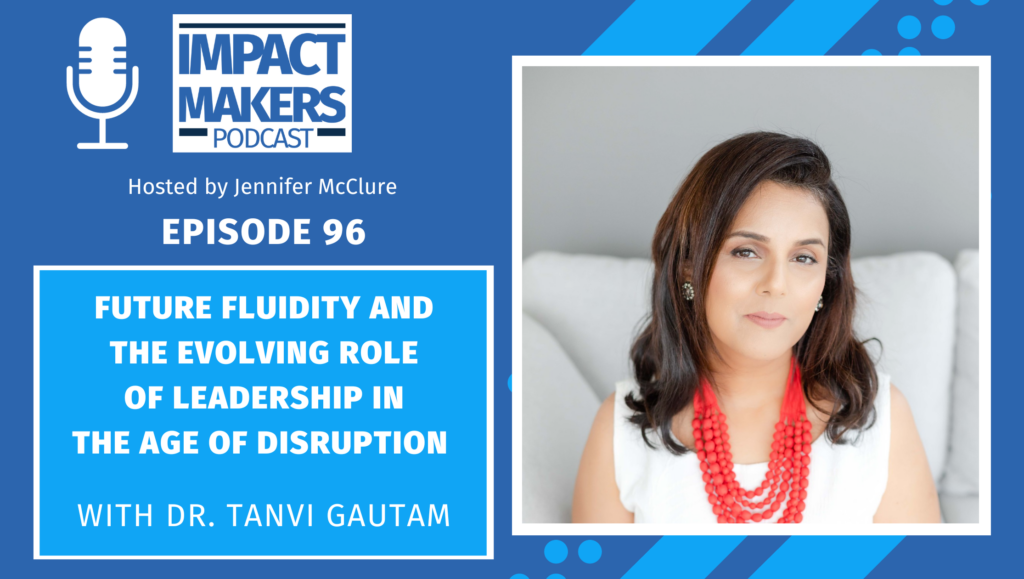
Future Fluidity and the Evolving Role of Leadership in the Age of Disruption With Dr. Tanvi Gautam

On episode 96 of the Impact Makers podcast, I welcome Dr. Tanvi Gautam, a world-renowned leadership development expert.

Dr. Gautam is a multi-award-winning keynote speaker, executive coach, author, and senior faculty and program director at Singapore Management University. She uses a combination of head and heart-based tools for upgrading leaders and to create culture transformation in organizations.

As we navigate a world rocked by global disruption, Dr. Gautam highlights how leadership is evolving and why it’s critical to adopt new tools and resources. She also shares her insights on the essence of true leadership, the essential leadership skills required in the age of disruption, and the intriguing concept of ‘future fluidity’.

Dr. Gautam shares how to cultivate flexibility and resilience — essential tools for navigating an uncertain future, and we explore the role technology plays in enhancing visibility and influence.

Whether you’re an emerging leader or an established executive, I think you’ll learn quite a bit from this episode, and will leave with practical steps you can take to evolve your own leadership skills.

Topics Discussed In Today’s Episode:

  • The focus of Dr. Gautam’s work – creating unstoppable leaders who can help their companies upgrade in the new age of disruption.
  • 4 skills that all leaders must develop to succeed in the future of work.
  • Why the tools, resources, and mindsets that made leaders successful in the past, are not what will be needed in the emerging world.
  • How viewing disruption and being disrupted as an invitation to reimagine and reinvent can create possibilities versus getting stuck or falling behind.
  • But how has leadership changed in a post-pandemic world?
  • Why developing the skills of rest and recovery will be a competitive advantage for both leaders and organizations.
  • The concept of “future fluidity”, and how developing this skill can help leaders to successfully navigate change and uncertainty.
  • Dr. Gautam’s forthcoming book – Deep Collaboration – will explore the five crucial conversations leaders must have to enable collaboration across organizational silos and boundaries.

LISTEN TO IMPACT MAKERS PODCAST – EPISODE 96

Listen on Apple podcasts, Google podcasts or Spotify

People & Resources Mentioned In This episode:

Dr. Tanvi Gautam – Website, LinkedIn, Twitter

Book — The Spark Lies Within: And other secrets of women leading inspired and authentic lives by Dr. Tanvi Gautam

WorkLife with Adam Grant Podcast: The Science of Recharging on Weekends and Vacations

Categories: Blog, Leadership, Podcast
Posted on October 19, 2023

Written by Jennifer McClure

The Best Articles & Resources for Leaders Transforming the Future of Work: September 2023

Each week, I send a brief email newsletter to leaders seeking to disrupt and transform the future of work.

In this weekly letter, I share my learnings and experiences from over 3 decades of work as a human resources leader, executive coach, and entrepreneur, along with tools, tips and resources that are personally curated to help leaders establish credibility, communicate confidently, and lead with impact.

If you’d like to receive the weekly Impact Makers email newsletter, you can subscribe HERE.

Following are a few of the best resources that I created, read, reviewed, and shared in the month of September 2023.

HIGH-IMPACT LEADERSHIP:

I’ve made it a personal goal to try to watch every DisruptHR Talk ever given. With over 6,500 videos (and growing every week) in our library, that goal may be slightly unreasonable. However, by watching at least a couple of videos each week, I find gems like this 5-minute DisruptHR ROC Talk by Cory Raggi, SHRM-SCP – Chief Operating Officer at RDG+Partners.

In this well-delivered Talk, Cory shares that being nice does not mean that we’re weak, submissive, or ineffective as leaders — and being positive doesn’t mean being that we’re being naive.

The Edge of Optimism | Cory Raggi | DisruptHR Talks ​

PERSONAL BRANDING / THOUGHT LEADERSHIP:

Have you noticed some of the new badges popping up on LinkedIn profiles designating someone as a “Top Human Resources Voice“, or “Top Leadership Voice“, or “Top Personal Branding Voice“, and wondered how you could get recognized for your expertise on LinkedIn? Well, I’ve got the scoop for you!

Collaborative articles are knowledge topics published by LinkedIn with insights and perspectives added by the LinkedIn community. These articles begin as AI-powered conversation starters, but anyone can add insights to share their knowledge and expertise, which makes the articles better.

I was pleased to recently receive a “Top Leadership Development Voice” badge, and I regularly look for opportunities to contribute to articles related to public speaking, personal branding, and human resources. I’d love to add those badges to my profile as well.

✏️ Find collaborative articles on LinkedIn to contribute to related to your areas of expertise (and maybe get your own Top Voice badge!)

When you meet someone new, how can you learn about their work quickly? How can you really get to know them and what matters to them — beyond their boilerplate (ahem: boring) job description? How do you get past the standard spiel and talk about the juiciest parts of their work? Lee Price shares 10 conversation quick-starters she uses to get people talking about their work.

​✏️ Conversation Quick-Starters: How to Get People Talking About Their Work by Lee Price

HUMAN RESOURCES / PEOPLE & CULTURE:

My good friends at Humareso are hosting The H-ROI Summit October 25th – 27th, 2023. This virtual learning opportunity is designed for leaders who are looking for a valuable learning experience that offers practical advice, instruction, and personalized coaching.

It’s led by actual HR practitioners Sarah Morgan, Keirsten Greggs, Lorena Pabon, MHSA, SHRM-CP, and BJ Anderson, SHRM-SCP, SPHR, so you know this will be good.

Register to attend: The Human Return on Investment Summit – H-ROI 2023

“What’s one of the most important but often overlooked skills that I’ve developed over my career as a Chief People Officer?”

Tracie Sponenberg recently shared her perspective on this question in a post here on LinkedIn, and she also shared a link to this interesting article, which provides you with a clue to her answer.

✏️ Adaptability in the workplace: Defining and improving this key skill via BetterUp

Gallup‘s research paints a grim portrait of corporate culture in the U.S., and a recent survey found that only 2 in 10 employees feel strongly connected to their organization’s culture. This article lays out the problem, and shares four steps that leaders can take to execute effective culture transformation.

✏️ Diagnosing a Broken Culture — and What to Do About It via Gallup

​Is it possible for companies to protect employee autonomy, engagement, and well-being, as well as job flexibility while also ensuring efficiency and productivity through a period of economic uncertainty and slower growth?

This author’s research into how organizations unlock the productivity of neurodivergent and disabled workers points to a way forward — one that allows leaders to accommodate the unique needs of every team member.

✏️ The Radical Promise of Truly Flexible Work via Harvard Business Review

Storytelling is indispensable in business, especially today and into the future, when alignment between mission, values, employees, and customers is more important than ever. Creating a compelling Purpose Story is the key to making your mission and values stick.

Storytelling in Business Case Study: Making Your Mission an Values Stick by Kindra Hall

Katrina Kibben is a prolific blogger and job post writing expert (If your job posts suck? They can help.) who curated and shared a list of interesting and helpful people in the HR, recruiting and DE&I spaces recommended for others to follow and learn from. I’m blessed to know and follow a little over half of the people on this list already, and I look forward to getting to know the others as well.

✏️ 19 Recruitment And HR Experts To Follow On LinkedIn by Katrina Kibben

RECRUITING & TALENT ACQUISITION:

Globally, approximately 150 million jobs will shift to workers 55 and older by the end of the decade. Yet, programs to support a multi-generational workforce are rare.

This report from Bain & Company Inc. emphasizes the necessity to retain and recruit older workers, to understand their workplace motivations, to re-skill them for the upcoming decade’s capability needs, and to leverage their strengths — allowing them to excel in their areas of expertise. Because we’re gonna need them.

Better with Age: The Rising Importance of Older Workers

BOOK OF THE MONTH:

Another mention here for Kindra Hall, a sought-after keynote speaker at conferences and corporate events who is an expert on the power of effective storytelling for individuals and businesses alike.

Her first book (published in 2019) highlights the transformative role of storytelling in business and identifies four essential brand stories: value, founder, purpose, and customer. This book is one of my favorite, and serves as a guide for crafting compelling stories and showcases their practical application in various contexts.

Stories That Stick: How Storytelling Can Captivate Customers, Influence Audiences, and Transform Your Business by Kindra Hall

FROM MY POINT OF VIEW:

New leaders: How can you lead with purpose, clarity, and vision?

In this article, I provide a roadmap for new leaders based on my decades of experience mentoring and coaching high-performing leaders. The 5 strategies shared will help you build trust with your team, and guide you as you shape your leadership legacy.

✏️ 5 Things New Leaders Should Do to Set Themselves Up for Success

In the current era of hybrid and remote work, fostering genuine employee connection is crucial for engagement and productivity, but achieving it requires a nuanced approach despite the ease of digital communication. In this article, I discuss the challenges of building a connected workplace, a story of a new hire almost lost due to these challenges, and what leaders can do to ensure that employees experience connection to their work, to their leader, to their team, and to the organization.

✏️ Employee Engagement in the Digital Age: The Essential Role of Connection in Remote Work

Can you describe your experience at your current company in one word?

The chances are high that this word – whether invigorating or daunting – offers a snapshot into your company’s culture.

In this article, I dive deep into the intangible yet powerful aspect of company culture. I also discuss its undeniable impact on your organization’s ability to attract top talent, boost employee engagement and productivity, reduce turnover, and enhance your employer brand.

✏️ How to Create a Company Culture That Attracts and Retains Top Talent: 4 Essential Elements

A well-crafted business case is essential for winning approval for proposals — even those with great potential. It’s not enough to simply present a solution; you must also define a clear and measurable problem, quantify the business impacts, and show how your ideas can solve the problem and improve results.

This article shares the story of an HR leader who was unable to get executive approval for a leadership development program, why her proposal was not successful, and what needed to be done to build a successful business case.

✏️ 4 Steps to Building a Business Case That Will Get Your Proposals Approved

THE IMPACT MAKERS PODCAST:

Episode 90 of the Impact Makers podcast features Innovation Coach Ellia Harris discussing creative problem-solving, ideation tools, AI tools like ChatGPT, and thinking outside the box.

If you’re stuck in the same thinking patterns, this episode can help you break out and find new and creative solutions to problems.

Simplify Creative Problem-Solving and Innovation Using Light Bulb Thinking™ With Innovation Coach Ellia Harris

On this episode of the Impact Makers podcast, leadership coach Sonya Shelton discusses the importance of having a clear vision for organizational success. Sonya shares actionable insights to identify your core ‘WHY’, and its pivotal role in leadership. She also talks about the symbiotic relationship between strategy and culture, and how to address the alarming rise in work-related stress.

Discovering Your Why: How Clarifying Your Vision Can Transform Your Organization and Create a Bigger Impact

On episode 92 of the Impact Makers podcast, Dr. Daniel Crosby and I unpack the art and science of what makes for an impactful presentation, as well as how to navigate the intricate dance of setting speaking fees that will get you booked and paid for the right opportunities to share your message with the ideal audience.

Whether you’re aiming to enhance your presentation skills or monetize your speaking prowess, this revealing conversation offers actionable steps and practical recommendations to elevate your game.

Creating High-Impact Presentations and Building a Profitable Speaking Business With Jennifer McClure and Dr. Daniel Crosby [Replay]​

In this episode of the Impact Makers podcast, I chat with my friend and professional resume writer Chris Villanueva about the evolving landscape of the future of work, the skills that will be most sought after in upcoming years, and strategies for effective networking in a world where more and more people are working remotely.

Whether you’re an ambitious job seeker or a business leader, this episode provides valuable insights for navigating career advancement and fostering meaningful relationships in the digital age.

My Best Career Advice to Position Yourself for the Job You Want with Jennifer McClure and Chris Villanueva​

FIND ME AT UPCOMING SPEAKING EVENTS & CONFERENCES:

October 11, 2023 – Corporate Client

(Workshop) “Hiring for Trust: Behavioral Interviewing for the Modern Manager”

October 25, 2023 – Corporate Client

(Workshop) “Hiring for Trust: Behavioral Interviewing for the Modern Manager”

October 26, 2023 – Broadview Heights, OH: Northeast Ohio SHRM

I’ll be discussing The Future of HR, along with John Bernatovicz, Tim Sackett, SPHR, SCP, George Sample, MBA, SPHR, and Lauren Rudman, SHRM-SCP, SPHR

October 25, 2023 – ComplianceIQ

(Webinar) “The Future of HR: 4 Strategies to Meet Business Challenges and Deliver Maximum Impact on Results”

November 13, 2023 – Washington, DC: National Association of Broadcasters Leadership Foundation Human Resources and Diversity, Equity and Inclusion Forum

(Keynote) “Future-Ready HR: Unlock Your Potential to Drive Business Success and Thrive in the Future of Work”

Categories: Blog, Human Resources, Leadership, Personal Branding, Recruiting
Posted on October 16, 2023

Written by Jennifer McClure

4 Steps to Building a Business Case That Will Get Your Proposals Approved

As a leader, you fill a critical role inside your company. You lead or initiate key projects that can positively – or negatively – impact business performance.

As a result, you must master the art of building (and selling) an effective business case in order to gain executive approval and implement key strategies necessary to achieve strategic business objectives.

Following a workshop that I delivered on the topic of “Building an Effective Business Case for Leadership Development” at a conference attended by senior human resources and talent acquisition leaders, one of the attendees came forward at the end of the workshop and explained to me that she was having difficulty getting her executive team to agree to move forward with a leadership development program she and her team had recently proposed.

Obviously frustrated, she was seeking any tips or tricks that I might be able to offer her to get the CEO and the executive team to buy-in to the proposed program that her team had spent months researching and creating.

Before offering any coaching or advice, I wanted to gather a little more information. So, I asked:

“Why did you initially decide to create a leadership development program?”

She thought for a minute, before jokingly saying,

“I don’t really know. I guess because it seems like the right thing to do.”

Okay. 🤔

Sensing why she might be having difficulty selling her proposal to the executive team, I tried another angle:

“Is there a specific problem in your organization that you believe implementing a leadership development program would solve?”

Seeing where the conversation was going, she smiled and said,

“I can’t really think of anything specific. I guess that’s a big part of the problem.” 

Boom! 💥

To gain approval for any new program, initiative, or process – basically anything that requires the decision to allocate money, time, or resources – business leaders MUST build an effective business case.

Four Critical Steps for Building a Successful Business Case

1. Define the problem.

Success Tip: Opportunities are problems with smiley faces.

Problems in need of a solution can come in the form of areas that cause pain, or areas that represent missed opportunities. There’s a reason that you’re compelled to investigate a solution.

To set your business case up for success, you’ve got to be able to articulate the source of pain or opportunity to your organization by using data.

If you can’t effectively explain the problem or opportunity? Then you’ll have even more difficulty explaining the need for a solution.

2. Quantify how the problem negatively impacts business results.

Success Tip: This is always about money.

Business executives speak the language of money.

To communicate with them effectively, you must be able to analyze available data, and explain how not solving the problem(s) identified is costing the company money – or where the opportunity to make money is not being capitalized upon because a solution has not yet been implemented.

If executives cannot see how failure to act on a problem negatively impacts their bonuses and the bottom line, they’ll apply their focus and resources elsewhere – and your business case will go nowhere.

3. Evaluate possible solutions and make a recommendation.

Success Tip: Always propose more than one possible solution.

The savvy business leader always explores and proposes multiple solutions – or versions of a solution – in order to open the minds of decision-makers to possibilities, rather than giving them only one option that they must approve or reject.

However, it’s not enough to just propose options.

The executive team will expect you to utilize data analysis, and your expertise, to recommend the best solution. They’ll also expect you to be able to defend your recommendation and to negotiate alternatives – because that’s how business gets done.

4. Quantify how your recommended solution positively impacts business results.

Success Tip: This is also always about money.

The final step in building an effective business case involves defining an implementation plan for your recommended solution, and detailing how successful implementation will enable the company to make more money, increase customer satisfaction, improve retention, improve employee engagement, etc. — in financial terms.

To get approved, a business case must include liberal use of numbers with currency signs and/or percentage symbols. Key words that executives pay attention to include increase, decrease, improve, grow, reduce, etc.

—

At the workshop I mentioned previously, after taking a few moments to share these critical steps for presenting a successful business case with my new friend, she left the workshop realizing that she had quite a bit of homework to do before making her proposal again — IF she was able to show that it was truly worth the investment of time and money by her organization.

I’m confident that by working through the four steps to building a successful business case listed above, she’ll increase her chances for gaining approval for her initiative — or have a better understanding as to why it’s not important to pursue.

And you can do this too.


As a keynote speaker and leadership coach, Jennifer McClure helps leaders to embrace the future of work, and to develop the skills necessary to lead their organizations and the people on their teams to take bold actions that positively impact business results.

Want more leadership and future of work insights from me?

SUBSCRIBE to get my weekly Impact Makers newsletter delivered to your inbox!

Categories: Blog, Leadership
Posted on September 19, 2023

  • 1
  • 2
  • 3
  • …
  • 10
  • Next Page »

Recent Posts

  • Why HR Should Be the Chief Disruption Officer in Every Organization
  • Mastering the Art of Virtual Networking: 5 Steps to Build Powerful Connections Online
  • Networking for Introverts: Practical Strategies for Building Meaningful Connections with Greg Roche
  • Leading with Vulnerability: The Key to Future-Ready Leadership with Jacob Morgan
  • Future Fluidity and the Evolving Role of Leadership in the Age of Disruption With Dr. Tanvi Gautam

Categories

Archives

Need A Speaker?

I've delivered keynotes and led workshops at over 350 conferences and corporate events.

If you want to check my availability for your event, or if you have questions, click below.

Start the Conversation »

Recent Blog Posts

  • Why HR Should Be the Chief Disruption Officer in Every Organization
  • Mastering the Art of Virtual Networking: 5 Steps to Build Powerful Connections Online
  • Networking for Introverts: Practical Strategies for Building Meaningful Connections with Greg Roche
  • Leading with Vulnerability: The Key to Future-Ready Leadership with Jacob Morgan
  • Future Fluidity and the Evolving Role of Leadership in the Age of Disruption With Dr. Tanvi Gautam

Connect on Social

  • Facebook
  • Instagram
  • LinkedIn
  • Twitter
  • Vimeo

Copyright © 2025 · Jennifer McClure · Privacy Policy

Copyright © 2025 · McClure Pro on Genesis Framework · WordPress · Log in