Jennifer McClure`

Equipping people leaders to navigate change — and design the future — with boldness and purpose.

  • About
  • Speaking
  • Schedule
  • Blog
  • Impact Makers Podcast
  • Contact

Written by Jennifer McClure

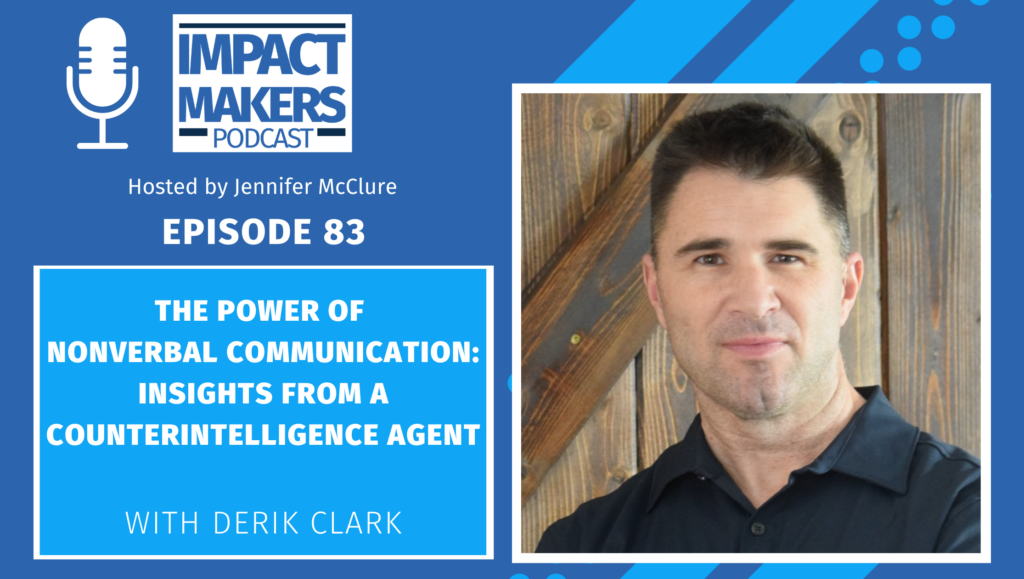
The Power of Nonverbal Communication: Insights from a Counterintelligence Agent with Derik Clark

Impact Makers podcast episode 83 with Derik Clark

On episode 83 of the Impact Makers podcast, I’m chatting with Derik Clark, a human resources leader and recently retired Army counterintelligence agent who has a passion for teaching others about the power of nonverbal communication.

Derik is a US Army veteran with 22 years of service, who specialized in counterintelligence investigations and intelligence informant operations. Through those responsibilities he became a subject matter expert in body language assessments and high stakes interviewing in threatening environments, and he’s taught those skills to thousands of US soldiers in both the official Army counterintelligence school, as well as in live environment military operations.

Derik founded Bodysights body language training to help leaders and organizations to notice key nonverbals during interviews, client interactions, investigations, performance reviews, and negotiations.

In our discussion, we chat about the importance of reading and understanding body language, and the impact it can have in various contexts, as well as how understanding these concepts can help leaders to foster stronger relationships, make better-informed decisions, and navigate complex interpersonal dynamics more effectively.

Topics Discussed In Today’s Episode:

  • The power of nonverbal communication and its impact on human interactions.
  • The limitations of relying solely on body language for determining truthfulness and the importance of considering other factors.
  • How social distancing and the shift to more digital communication has impacted our ability to read body language and facial expressions, which helps us to perceive comfort levels and emotions.
  • Why demonstrating empathy is the key to deepening connection, and encouraging open and honest discussions.
  • The value of training to develop effective nonverbal observation skills and categorizing comfort levels.
  • The importance of considering diverse factors like neurodivergence, cultural differences, upbringing, and personal trauma when assessing body language, especially in job interviews or other stressful situations.
  • Enhancing hiring decisions, employee investigations, and communication skills through improved body language understanding.
  • The practical applications of nonverbal communication in business contexts.

LISTEN TO IMPACT MAKERS PODCAST – EPISODE 83

Listen on Apple podcasts, Google podcasts or Spotify
People & Resources Mentioned In This episode:

Derik Clark – Website, LinkedIn

Categories: Blog, Effective Communication, Interviewing, Podcast
Posted on July 17, 2023

Written by Jennifer McClure

Build a Powerful LinkedIn Profile to Showcase Your Personal Brand and Career Success

As someone who has been active on social media platforms for many years, and regularly speaks on the topic of Personal Branding, I’m often asked the question:

Is it still possible to use social media to build and extend your Personal Brand?

The short answer is – Yes. Absolutely!

While social media has changed and evolved over the last couple of decades, I believe that engaging on social media platforms where your people hang out is still a good investment of your time, so you can connect with and learn from others, establish your credibility, build your personal brand or business brand, and grow your career.

So, where do “your people” hang out online?

If you’re a business leader, there’s no doubt that LinkedIn – the “professional” social network that has been around since 2002 – is the most beneficial place for you to engage online, and is worth the investment of your time — especially if you’re looking to grow your career and your business, and to attract opportunities.

But even though LinkedIn is pretty straightforward – create a profile, connect with people, post and share ideas, etc. — you’re likely not getting the most out of your time there that you could, if you were to create an intentional strategy for using the platform.

By being intentional about how you use LinkedIn, you can build your credibility as a thought leader, your reputation as a business leader that others want to work with or do business with, and readily access a vast network of people and resources that you can utilize (for free) for your personal and professional development.

How can you get the most out of your time on LinkedIn?

First, it’s important that you create a LinkedIn profile (or update your current one) that sets you up to achieve your career goals. Starting with your professional profile is important, because it’s extremely valuable online real estate.

How valuable is your LinkedIn profile?

Using your phone or desktop right now, open your favorite search engine – for example, Google. Type your name in quotes (ex. “Jennifer McClure”), and press enter.

You’ll likely notice that the first page of search results for your name returns several websites and social media profiles of others that share your same name, and if you’re lucky, the top 10 search results will include a link to your public LinkedIn profile, or at least one created by one of your namesakes.

For example, in my case, there are quite a few Jennifer McClures that have a strong online presence, and while the search results for my name will vary somewhat from day to day, it’s almost always the Jennifer McClure who owns the .com website for our name that comes up first.

JenniferMcClure.net – my business website – and typically shows up as the third result for my name – which is still pretty good. But do you know what almost always shows up as the number 2 search result for all of the Jennifer McClures?

Yep, you got it. My LinkedIn profile.

So, while Jennifer McClure the photographer will always own the most valuable real estate online for our name (until I win the Mega Millions lottery and offer her enough money to part ways with it), my LinkedIn profile is doing some pretty heavy lifting for my personal and business brand.

Why is that?

I’m no SEO expert, but from what I do understand, the fact that the LinkedIn website is trusted and highly active – with over 900 million users clicking around on their site every day – search engines believe that serving up a LinkedIn profile link high in search results will likely be a strong match for the person that you’re searching for.

Couple that with the fact that I’m a very active user of LinkedIn, with almost 30,000 first-degree connections, and over 200,000 followers, it’s one of the best places for someone searching for me to start in order to determine if they’ve found the right person.

If you’re a business professional, your best opportunity to get noticed online is to have a robust, fully complete, and active LinkedIn profile.

People ARE searching for you online – or they should be – and you have a simple (and free) way available to you to deliver exactly the credibility, image, and authority that you prefer, by being intentional about how you use LinkedIn.

What makes a LinkedIn profile great?

From my research, and from my personal experience as an early-adopter and power-user on LinkedIn for over 15 years — by the way, I’m member number 5,852,039 on the platform — here are the minimum steps that you should take to make your LinkedIn profile work for you:

Use a high-quality head shot for your profile photo.

Your LinkedIn profile photo is your first chance to communicate that you’re friendly, likable, and trustworthy — which, whether we like it or not, are attributes that are crucial to establishing credibility and connection.

We’ve all heard the phrase: “People do business with people that they know, like, and trust”.

If you want to be successful, it’s important to do everything that you can to establish that type of credibility in your personal and professional relationships — as well as online — which is where many first interactions occur these days.

LinkedIn research shows that simply having a profile photo results in up to 21x more profile views, and 9x more connection requests.

Below are 7 Profile Photo Best Practices, summarized straight from the LinkedIn Talent Blog – if you’d like to make sure that your profile photo sets you up for success on LinkedIn:

Tip #1: Pick a photo that looks like you.

Make sure that your LinkedIn profile photo is up to date and reflects how you look on a daily basis – or at least on the days when you’re at “work”.

In other words, if you were planning to meet with someone in-person today, would they be able to recognize you from your LinkedIn profile photo?

Tip #2: Use a high-resolution image, and make sure your face fills at least 60% of the frame.

The ideal size for your LinkedIn profile picture is 400 x 400 pixels. If it’s smaller than that, it will be blurry. If it’s not a square image, then your face will likely be distorted when it’s resized by the back-end website design.

Tip #3: Be the only person in your profile picture.

If you use a group photo as your profile picture, I’m not sure which person is you.

If you want to include a team picture on your profile, use that one for your background image instead, which I’ll share more about below.

Tip #4: Get someone else to take your profile photo.

Did you know that the front or selfie camera on most phones produces a lower-quality image than the rear camera?

To remedy that, you could use the rear-facing camera and the built-in timer to take your own photo, but by getting someone else to take the picture for you, you’ll likely find that you’ll pose more naturally and comfortably, and you also won’t be out of breath from running from the camera to strike a pose just in time.

Tip #5: Take a photo with the “right” expression.

In other words, smile!

A recent study published in January 2023 of 800 profile pictures revealed that people viewed the person in the photo as more likable, competent, and influential if they’re smiling in their picture.

“By far the most impactful characteristic we found in this study, though, is a particular kind of smile. A smile with teeth visible gains an average of +0.33 for Competence, +1.35 for Likability, and +0.22 for Influence. 

To our surprise, a closed mouth smile has about half the effect on Likability and no statistically significant effect on Competence or Influence. 

Too much of a good thing can backfire, though. If you take your open mouth smile one step further into a laughing smile, you’ll get a Likability push up to +1.49 but lose your gains on perceived Competence and Influence.”

(Smiling is complicated, ya’ll.) 😊

If that all sounds confusing, my best advice for you? Just be your best self.

Tip #6: Avoid distracting backgrounds.

Don’t have anything in your background that distracts from your face.

Find a simple background that can help ensure that you’re the focal point. Your background doesn’t have to be a white, empty space. You can take a picture outside in nature, or against a painted wall. Just keep things simple without being boring.

Tip #7: Dress like you do at work, or for the environment where you want to work.

If you don’t want to wear a suit at work, don’t wear a suit in your profile photo just because that seems “professional”.

Your goal should be to show your true self that you’re most comfortable with both in-person and online, so the people who are the “your people” will want to connect with, work with, hire, and promote you.

Background or cover images on LinkedIn

At the top of your LinkedIn profile, you have an opportunity to add a background photo, which shows up behind the small box that includes your profile photo.

Use this opportunity to showcase more of your company or personal brand, to share your logo, a photo of your team, or a cool location in your workplace or city.

For example, my current background photo on my LinkedIn profile is an image of me speaking in front of a large audience. As a keynote speaker, this allows people to see me in action, and adds credibility that I actually do what my profile says that I do.

Best branding opportunity? Your headline.

The headline on your LinkedIn profile is the sentence or words that show up directly underneath your profile photo. If you do nothing to change the headline, it will default to your current or most recent job title and company name.

So, if you’re the Human Resources Director at Acme Corporation, that’s what your headline will reflect — which doesn’t distinguish you from the thousands of other HR professionals on LinkedIn in any way.

Personally, I’d be much more interested in learning more about someone whose headline is — “I help burned out and frustrated HR Professionals to take control of their careers.”

In one brief sentence, I know what Julie Turney, (HRforHR) does, who she helps, and how she does it — AND I want to know more.

(Learn more about Julie Turney in episode 44 of the Impact Makers podcast – Get Out of Your Head and Just Get Things Done.)

Or, how about Josh Bersin‘s headline? “Global Industry Analyst, I study all aspects of HR, business leadership, corporate L&D, recruiting, and HR technology.”

Even if you don’t know Josh (one of the leading researchers and voices in the people and HR Technology spaces), you get a clear idea of what he does in just 17 words.

Tips for creating an effective LinkedIn profile headline:

Your headline should be more than your job title and company name.

For the last 13 years, I’ve spoken frequently on the topic of Personal Branding. In my workshops and training courses, I teach leaders how to understand and clarify their personal brand, and how to use the following formula to create a Personal Brand Statement that they can then use to describe what they do in a concise sentence.

I am ___ (your professional identity), who helps ___ (your audience) do or understand ___ (your unique solution), so that __ (the transformation or benefit you create).

Want to create a great Personal Brand Statement that describes you well, and helps you to create a great LinkedIn profile headline? Download a copy of my Personal Brand Workbook, a free 16-page guide designed to help you work through the types of work where you’re at your best, what you enjoy doing the most, and what opportunities you’d like to pursue. 

A good LinkedIn headline helps people who are viewing your profile to understand your unique talents, how you create value, and the impact that you create.

Finally, let’s cover one most important sections of your LinkedIn profile – your About section, or Summary.

Your goal should be to make your profile summary one that gets read and helps readers to understand the work that you do, who you help, and how you create impact. It should read like your very own marketing brochure – not like your resume.

The most interesting and effective LinkedIn profile summaries are written in first person, and tell a story that showcases your thought leadership, and highlights your unique perspective, insights, and accomplishments, as well as the impact you’ve made in previous roles.

For a great example of a well-written profile summary, check out one that my friend Amber Naslund — a great writer, and also an executive who works at LinkedIn — used previously as her LinkedIn summary:

(Learn more about Amber Naslund in episode 50 of the Impact Makers podcast — Balancing a Strong Personal Brand With a High Profile Corporate Career.)

By reading this profile summary, I know exactly what Amber does in her day-to-day work. I understand how she got there, and what she brings to the table that makes her work and life experience unique and compelling. This work summary isn’t boring, and she also shares a bit about her life and interests outside of work. (And if you know me, any summary that mentions horses will most certainly capture my attention.) 🙂

You can get some great ideas for writing or revising your own LinkedIn profile summary by checking out some tips and examples over on the LinkedIn Talent Blog — 14 LinkedIn Profile Summaries That We Love (And How to Boost Your Own.)

Now is a great time to review, revise, and update your own LinkedIn profile.

Using the tips above, you’ll increase your chances of getting noticed (by the right people), and creating opportunities to grow yourself and your career.

Categories: Blog, Personal Branding
Posted on July 11, 2023

Written by Jennifer McClure

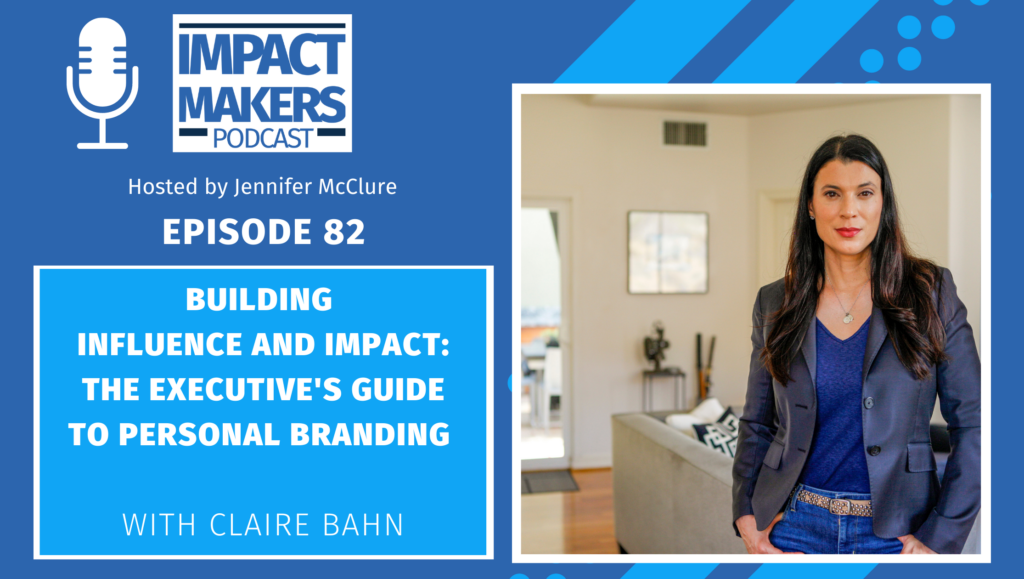
Building Influence and Impact: The Executive’s Guide to Personal Branding With Claire Bahn

Impact Makers podcast episode 82 - Claire Bahn

On episode 082 of the Impact Makers podcast, I chat with Claire Bahn, the CEO and Founder of Claire Bahn Group, a strategic marketing communications and branding agency.

For over 15 years, Claire has been helping leading businesses, high-achieving CEOs, executives, investors, and founders to maximize their authority and influence in order to accelerate business growth, gain recognition and increase opportunities.

In our conversation today, we dive into the concept of personal branding, why it’s important for everyone – but especially for executives – and what it takes to develop an effective personal brand in a world where most everyone is sharing online, and AI is being used more than ever to create content for people who may not have been previously good at it.

Topics Discussed In Today’s Episode:

  • What personal branding is, how it’s changed over the last few years, and why it goes well beyond visual elements like colors and logos.
  • Why differentiation is key to developing a successful personal brand, and key steps to take to determine what makes you different.
  • How CEO  and executive personal branding can positively impact a company’s brand.
  • Should you share only business/professional content online, or should you also be sharing more of your personal life? Does that help or hurt your personal brand and business?
  • Why storytelling – and the ability to tell a story well – is key to building and communicating an effective personal brand.
  • Do you have to do video in order to really stand out with your personal brand?
  • How AI is impacting personal branding, and what you need to focus on in order to keep your brand personal and differentiated.

LISTEN TO IMPACT MAKERS PODCAST – EPISODE 82

Listen on Apple podcasts, Google podcasts or Spotify
Supporting Links and Resources:

Claire Bahn – Website, YouTube, LinkedIn, Instagram, Facebook, Twitter

Categories: Blog, Personal Branding, Podcast
Posted on July 7, 2023

Written by Jennifer McClure

10 Critical Focus Areas for Leadership Success in the Future of Work

Unlocking the full potential of your team and paving the way for success in the future of work requires strategic focus and deliberate action. As a leader, it’s crucial to prioritize key areas that will make a significant impact on your organization and its employees.

In the ever-changing world of work, where technology advancements, globalization, demographic shifts, and changing societal norms continue to reshape the way we live and work, where should you focus, in order to create the most impact in your organization, and in the lives of the people that you lead and serve?

10 Critical Focus Areas for Leadership Success in the Future of Work

1. Fight for flexibility for your team members

People want to effortlessly work how, where, when, and for whom they want.

  • 40% of respondents in McKinsey’s Great Attrition Great Attraction Survey published in September 2021, said that flexibility was the number one reason they accepted their current job.
  • According to Shiftboard’s State of the Hourly Worker Report scheduling is the #1 complaint of hourly workers and the #1 cause of turnover.
  • 85% of the hourly workers who participated in Shiftboard’s survey reported that scheduling affects their overall job satisfaction.
2. Prioritize career growth and development opportunities for your people

According to Gloat Research Group’s Great Resignation 2.0 Report, the number one reason given by employees who took a new job as to why they would leave again was a lack of career development opportunities.

The same survey revealed that 54% of the employees surveyed reported that their employers either don’t take their future interests and aspirations into consideration enough, or not at all.

3. Help your people to connect with Meaning and Purpose in their work

It’s critically important for leaders to connect people to something bigger than themselves and help them contribute.

According to Gallup research, a 10% improvement in employees’ connection with the Mission or Purpose of their organization leads to an 8.1% decrease in turnover and a 4.4% increase in profitability.

I love this quote from Laszlo Bock – the current CEO & Co-Founder of Humu and former Google SVP of People Operations:

The single biggest thing you can do [as a leader] is to make the work feel meaningful.

What is an organization’s Purpose? It’s the reason for its existence, and the ultimate goal it seeks to achieve for customers.

Some good examples of organizational Purpose include:

  • Nourishing families so they can flourish and thrive – Kellogg
  • We fulfill dreams of personal freedom – Harley Davidson
  • We help people get jobs – Indeed.com
4. Commit to real change and action with Diversity, Equity, Inclusion, and Belonging efforts

How can you begin to make DEI&B efforts more meaningful and real in your organization?

  • Set meaningful goals
  • Track progress
  • Hold leaders accountable
  • Incentivize leaders

To learn more about how to think and act strategically when it comes to DEI&B, check out  Impact Makers podcast Episode #51 – The Value of Taking a Strategic Approach to Diversity, Equity, and Inclusion with Jennifer Ingram (she, her, hers) – Founder and CEO of Calibrated Lens.

5. Invest in your leaders – specifically front-line supervisors

The biggest gains businesses will witness in the future will come from hiring and training the right managers, who care for, develop, and maximize the strengths of every single employee.

Per Gallup’s meta-analytics based upon 100 million employee interviews 70% of the variance between highest engaged teams and persistently disengaged teams is just the manager.

6. Focus on skills identification and development

I think this quote from Jonas Prising – Chairman & CEO of ManpowerGroup, sums up this critical focus area in future of work well:

Helping people to pre-skill, upskill and reskill for in-demand roles in this Skills Revolution remains the defining challenge of this decade.

It was important before the pandemic, and is even more critical now – to create a better workplace where everyone is able to unleash their full human potential and have a more equitable share of the prosperity.

To learn more about best practices related to internal mobility and career upskilling, check out Impact Makers podcast Episode #64: Creating Career Pathways to Unlock Opportunity for the Workforce of the Future with Matthew Daniel – Principal, Talent Strategy and Mobility at Guild Education.

7. SEE your people

What do I mean by “SEE” your people?  

  • Show Appreciation.
  • Give Recognition.
  • Value Differences.

According to the results of a SurveyMonkey / Bonusly Survey, 63% of employees who are regularly recognized were “very unlikely” to look for a job in the next 6 months, and 89% of employees who are rarely recognized are open to accepting a new job.

And according to McKinsey’s Great Attrition Great Attraction Survey, the number one reason why people left a job without another one in hand was uncaring leaders.

In addition to helping your people to feel more valued, being a caring leader for your people actually makes good business sense.

8. Grow yourself

Your growth and development is your own responsibility, not that of your company, or your your boss. Take ownership of your personal development by:

  • Setting goals, tracking your progress, and holding yourself accountable.
  • Challenging yourself to learn aspects of business and leadership that are not within your current responsibilities.

As my friend Laurie Ruettimann says in her best-selling book Betting on You: How to Put Yourself First and (Finally) Take Control of Your Career:

If you’re learning, you’re growing, and if you’re growing, you’re thriving.

9. Develop your influence

As a leader, your ability to influence others is a critical factor in your career growth and success.

How can you develop your influence?

  • Invest in relationships.
  • Build trust.
  • Share your ideas.

My friend Neil Morrison – Group HR Director at Severn Trent Water, shared the following quote in a blog post years ago, which continues to resonate with me, because it’s so true:

You don’t get influence through control. You get influence through other people’s positive experience of you. You get influence through people wanting you involved – not by telling them you have to be.

10. Embrace (and lead) disruption

Change is a constant, and will continue at a rapid pace in the future. As leaders, we need to stay curious, and seek out ways to lead change efforts, rather than being reactive, and being affected by changes in unknown ways.

For HR and People leaders in particular, change agility was identified as a key skill in the future of work by SHRM research.

You can learn more about what the future of work holds for HR and People Leaders in Impact Makers podcast Episode #63: Defining Return on Workforce Investment in the Future of Work with Alexander Alonso, PhD SHRM-SCP – Chief Knowledge Officer at SHRM.

—–

So there you have it!

My 10 suggestions for areas where I believe leaders who will create positive and meaningful impact in the future of work need to focus now. Hopefully, you’re already actively making progress in several of these areas, and only need to add a few to your actions plans. Or, if you’re just getting started, choose a couple of areas to focus on, and start taking action today.

Categories: Blog, Future of Work, Leadership
Posted on July 5, 2023

Written by Jennifer McClure

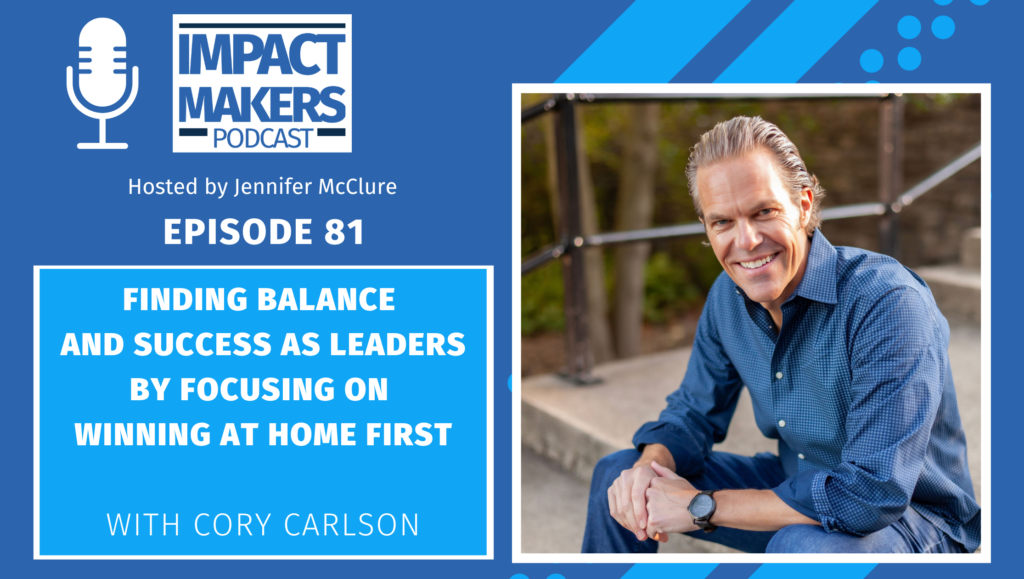
Finding Balance and Success as Leaders by Focusing on Winning at Home First With Cory Carlson

On this episode of the Impact Makers podcast, I’m chatting with Cory Carlson, an executive coach and speaker, who helps leaders win both at home and at work.

With over 20 years of corporate experience, including managing large teams and holding executive positions, Cory understands the challenges and pressures that many leaders face firsthand.

In our conversation, he shares his personal journey of self-discovery as a leader, from battling with imposter syndrome to finding a better way to lead. He also opens up about the pivotal moment in his career that led him to seek out an executive coach, and how that decision helped him to transform his life, while also becoming a better father, husband, and leader.

We chat about some of the key lessons that he learned along the way, and we discuss the importance of embracing coaching, focusing on what truly matters, and maintaining a healthy work-life balance.

Cory’s insights and practical strategies are not only beneficial for leaders but for anyone seeking personal growth and fulfillment. Whether you’re a seasoned executive or aspiring to make a meaningful impact, this episode is packed with valuable takeaways to inspire and empower you on your own career and life journey.

Topics Discussed In Today’s Episode:

  • The biggest challenge facing leaders today in regards to prioritizing both their work life and home life.
  • How leaders can address the need to be constantly available to their teams, and “always on the clock”, which can negatively impact their home life and relationships outside of work.
  • The life experiences that prompted Cory to write two business books focused on leaders – Win at Home First, and Rise and Go.
  • Why creating time and space to spend in solitude is important for improving self awareness and emotional balance.
  • The importance of shifting from a scarcity mindset to an abundant mindset, and simple steps that leaders can take to create a more positive mindset and enhance their overall well-being.
  • Where Cory believes leaders have the opportunity to create the greatest impact in the world today.

LISTEN TO IMPACT MAKERS PODCAST – EPISODE 81

Listen on Apple podcasts, Google podcasts or Spotify
Supporting Links and Resources:

Cory Carlson – Website, LinkedIn, Instagram

Win at Home First podcast

Win at Home First: An Inspirational Guide to Work-Life Balance by Cory M. Carlson

Rise and Go: How to Get Back Up with Courage and Move Forward with Confidence by Cory M. Carlson

Categories: Blog, Leadership, Podcast
Posted on July 3, 2023

  • « Previous Page
  • 1
  • …
  • 5
  • 6
  • 7
  • 8
  • 9
  • …
  • 57
  • Next Page »

Recent Posts

  • Why HR Should Be the Chief Disruption Officer in Every Organization
  • Mastering the Art of Virtual Networking: 5 Steps to Build Powerful Connections Online
  • Networking for Introverts: Practical Strategies for Building Meaningful Connections with Greg Roche
  • Leading with Vulnerability: The Key to Future-Ready Leadership with Jacob Morgan
  • Future Fluidity and the Evolving Role of Leadership in the Age of Disruption With Dr. Tanvi Gautam

Categories

Archives

Need A Speaker?

I've delivered keynotes and led workshops at over 350 conferences and corporate events.

If you want to check my availability for your event, or if you have questions, click below.

Start the Conversation »

Recent Blog Posts

  • Why HR Should Be the Chief Disruption Officer in Every Organization
  • Mastering the Art of Virtual Networking: 5 Steps to Build Powerful Connections Online
  • Networking for Introverts: Practical Strategies for Building Meaningful Connections with Greg Roche
  • Leading with Vulnerability: The Key to Future-Ready Leadership with Jacob Morgan
  • Future Fluidity and the Evolving Role of Leadership in the Age of Disruption With Dr. Tanvi Gautam

Connect on Social

  • Facebook
  • Instagram
  • LinkedIn
  • Twitter
  • Vimeo

Copyright © 2026 · Jennifer McClure · Privacy Policy

Copyright © 2026 · McClure Pro on Genesis Framework · WordPress · Log in