Jennifer McClure`

Equipping people leaders to navigate change — and design the future — with boldness and purpose.

  • About
  • Speaking
  • Schedule
  • Blog
  • Impact Makers Podcast
  • Contact

Written by Jennifer McClure

How to Create a Company Culture That Attracts and Retains Top Talent: 4 Essential Elements

Quick request: Think about the company you’ve either loved or hated working at the most in your career…

If you had to describe your experience working at the company in just one word, what would that word be?

I’m going to make a confident bet that the first word that came to mind for you is related to the company’s culture.

Whether your word is something like caring, fun, challenging – or stressful, discouraging, difficult – your one-word assessment is a direct reflection of how YOU experienced the company’s culture.

Does this mean that your experience is the same as others who have worked for the organization? Not necessarily.

While one person may find an environment that’s fast paced and low rules to be energizing, another person who enjoys working in an environment that’s more laid back and structured may find that same environment to be extremely stressful.

Does that mean that something’s wrong with a company’s culture, because one person finds it to be a place where they’re very satisfied, while another is unhappy?

Nope.

What exactly is company culture?

The Great Place To Work® Institute defines company culture as follows:

Company culture is how you do what you do in the workplace. It’s the sum of your formal and informal systems and behaviors and values, all of which create an experience for your employees and customers.

At its core, company culture is how things get done around the workplace. “How” includes both the formal systems, and the informal behaviors.

What makes a company culture “successful”?

1. Established Values That Are Visibly in Action

The foundation of a successful company culture is a clear set of values. These values must be clearly understood and communicated, and the company’s leadership must be supported — as well as rewarded — for “walking the talk” and enforcing those values with their teams.

A great example of this is Hubspot, which clearly articulates who they aspire to be as a company on their website:

We’re building a culture where personal and professional growth are just as important as business growth. That’s why we created the HubSpot Culture Code. It shares our key values, like HEART — humble, empathetic, adaptable, remarkable, and transparent — and much more.

In their 128 page Culture Code slide deck, Hubspot states:

“We don’t just believe in these values, WE BET ON THEM. We recruit, reward and release people based on these values.”

The company also reinforces their values with THE HEART AWARDS, which are awarded to those who live those values every day and make others proud to work at HubSpot.

2. Awareness and Authentic Communication

How well a company understands their culture and communicates about it honestly and visibly is a key factor in both their leaders making good hiring decisions, and in prospective employees being able to determine if a workplace is one where they can thrive – or one that they should avoid like the plague.

For example, before starting my own business, I worked in three different HR leadership roles in start-up, high growth, and turnaround environments.

How would I describe those experiences? Fun. Challenging. Stressful.

And I loved almost every minute of it. Without consciously thinking about it at the time, I can now see that I was drawn to opportunities where the challenges were growth, change, and overcoming resistance.

However, in those same environments where I thrived, others were miserable. For some of my colleagues, consistent change, dealing with unknowns, and constant pressure to solve big problems was overwhelming – not energizing.

I learned that when it came to recruiting and hiring for each of those companies, it was critically important that we understood the work experience that we were offering to current and future employees and communicated those challenges/opportunities in our employment branding efforts, as well as during the interview process.

As my friend Kris Dunn, SVP of Global Talent Acquisition at Marriott International and author of The 9 Faces of HR: A Disruptor’s Guide to Mastering Innovation and Driving Real Change says in one of his classic DisruptHR Talks from a few years ago – Who To Hire When Your Culture Sucks:

“If you have a freak show, go ahead and tell the world you’re a freak show. You’ll actually get better matches, and people will think you’re authentic.”  

Whether your company is a loveable “freak show” where only the strong survive, or it’s a Zen garden where the brightest minds blossom in tranquility — or somewhere in between — the most important thing is that you call it what it is. Because if you don’t, you’ll be called out by others who found out too late, and that can prevent you from being able to attract (and retain) the great talent that is truly a match for your culture.

3. Consistent Evaluation and Evolution

While it’s important for companies to have founding principles that establish and drive culture initially, the reality is that in our constantly changing world, company cultures must evolve and change as well.

To evaluate your company’s culture, I’d suggest at least a semi-annual review of employee satisfaction surveys, as well as customer feedback to understand how your culture is performing.

If feedback and results are positive, then no change may be necessary. But even when feedback is positive regarding the current state, maybe there are challenges ahead within your industry, or with the environment (workforce trends, economic shifts, societal norms, etc.) that will require removing, changing, or adding new values to create and sustain an environment that supports the company’s goals.

Companies that aren’t consistently doing a “culture check” may find themselves in a situation similar to the one faced in recent years by Uber.

Of course, Uber is known for completely disrupting an industry, and consistently having to overcome extreme resistance to change the way we think about transportation. When the company was founded, their original values included Meritocracy, Toe-stepping, Superpumped, and Always Be Hustlin’.

However, as the business matured, and the internal and external work environments evolved, this type of culture no longer served them well, and that led the company to near catastrophic failure. After several negative events involving both employees and customers, the company was forced to make significant changes in both their leadership, and their values, in order to survive.

4. Culture Is Not One Size Fits All

The importance of company culture, and what it is/what it isn’t doesn’t have to continue being debated. We all know it’s important, and every company is different. The path to success is not in trying to make your culture like another company’s, but to determine the values that you want to infuse into your own workplace, to communicate and re-enforce those values, and to be willing to change them as needed to meet the needs of our employees and customers.

The world — and the world of work — has dramatically changed over the last few years and will continue to change at a faster pace than ever before.

As a leader, one of your most important responsibilities is to ensure that your organization can attract and retain the RIGHT PEOPLE who not only have the skills necessary to do the work, but also are aligned with how the work is expected to be done (your company’s culture.)

_______________________________________________

As a keynote speaker and leadership coach, Jennifer McClure helps leaders to embrace the future of work, and to develop the skills necessary to lead their organizations and the people on their teams to take bold actions that positively impact business results.

Want more leadership and future of work insights from me?

SUBSCRIBE to get my weekly Impact Makers newsletter delivered to your inbox!

Categories: Blog, Company Culture, Employee Engagement
Posted on September 26, 2023

Written by Jennifer McClure

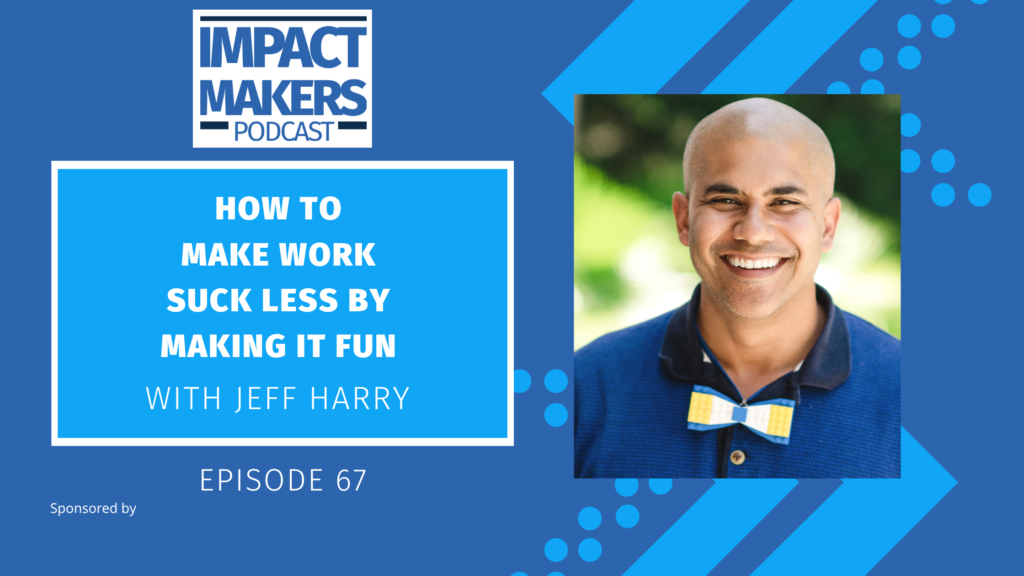
How to Make Work Suck Less By Making It Fun with Jeff Harry

Impact Makers Podcast Episode 067

These days, every workplace expert and futurist worth their salt is talking about The Great Resignation, Quiet Quitting, burnout, and dwindling employee engagement levels.

Some are even offering solutions to these problems, including showing more empathy, focusing on improving access to mental health benefits, offering more workplace flexibility, and suggesting increased communication from leadership.

But I’ve not heard anyone suggesting that we can address these issues through introducing more play and fun in the workplace – until I met today’s guest, Jeff Harry of Rediscover Your Play.

Jeff is passionate about making work suck less, and he does this by assisting leaders in building a workplace where individuals learn how to tap into their true selves, to feel their happiest and most fulfilled–all through play!

Topics Discussed In This Episode:

  • The two questions to ask your leaders to understand your company culture.
  • The difference between forced fun, and introducing play in the workplace.
  • Why allowing yourself to get bored is the key to unlocking creativity and innovation.
  • How to address quiet quitting through play.
  • Why psychological safety is required before introducing fun or play into the workplace.
  • The reason why meetings suck, and what you can do to fix it.
  • How what drove you back when you were a kid can really answer  questions like “How do you  want to show up in the world?”
  • How can you cultivate the next great idea?
  • How to add more play to your grown-up life.

IMPACT MAKERS PODCAST – EPISODE 67

Key Quotes From This Episode:

“What is the worst behavior you are currently tolerating [in your workplace]? Because that sets the tone, that sets the culture.” ~ @Jeff Harry

“Allow yourself to get bored the way you got bored as a kid. And then, when you get bored and…you’re not being inundated by information or not looking at information, then just see what ideas start to come up.” ~ @Jeff Harry

“Challenge the status quo because clearly it’s not working for a majority of people if we have such high disengagement, such high absenteeism and, such a movement around like anti-work or Quiet Quitting.” ~ @Jeff Harry

People & Resources Mentioned In This Episode:

Workplace from Meta

Rediscover Your Play 

Jeff Harry LinkedIn 

Play-Well TEKnologies – Teaching Engineering to Kids

Gary Ware – Breakthrough Play

Impact Makers Podcast Episode 67: Building a Culture of Mindfulness and Supporting Employee Mental Health with Headspace CPO Désirée Pascual

Braver Angels

harkness.ai

Lauren Yee – Cultivator of Curiosity

Show Sponsor:

This episode of the Impact Makers Podcast is sponsored by Workplace from Meta.

Everybody’s talking about the metaverse these days, but Workplace from Meta is different – I mean, the clue’s in the name, right?

Workplace is a business communication tool that uses features like instant messaging and video calls to help people share information. Think Facebook, but for your company.

It’s part of Meta’s vision for the future of work – a future in which your job isn’t just something you do, but something you EXPERIENCE. A future in which we’ll all feel more present, connected, and productive.

Start your journey into the future of work at workplace.com/future.

Connect with Jennifer:

Send her a message [https://jennifermcclure.net/contact/]

On LinkedIn: http://www.linkedin.com/in/jennifermcclure

On Twitter: https://twitter.com/JenniferMcClure

On Instagram: https://www.instagram.com/jennifer_mcclure/

On Facebook: http://www.facebook.com/JenniferMcClureSpeaker

Categories: Employee Engagement, Leadership, Podcast
Posted on October 20, 2022

Written by Jennifer McClure

Hiring for “Cultural Fit” – How Do You Make It Tangible?

Today’s post is a guest post from the folks at Halogen Software.

Why would I turn over this “valuable” real-estate to a vendor in the HR space when I don’t accept advertising on my blog? Because they actually read some posts from my blog and sent me a personal email suggesting several topics that they could contribute a post on within the areas I typically write about – without directly promoting their products. As someone who gets several non-personalized and non-related pitches per day, I found the interaction refreshing – and I’m always interested in reading/learning from other’s perspectives.

So give it up for Sean Conrad and Halogen Software sharing some tips on Hiring for Cultural Fit…

—

When it comes to hiring, it’s easy for recruiters, HR and hiring managers to focus on a candidate’s technical qualifications and skip right over the things that are harder to quantify – like cultural fit.

While corporate culture is somewhat intangible, it’s also a critical asset to your organization, one that needs to be carefully considered as part of the hiring process.

Why? Well, when you consider the costs of a poor hire – with estimates running as high as $300,000 to $500,000 (Dr. John Sullivan) – hiring for cultural fit has a huge impact. Of course every HR professional is looking to find and hire candidates who will excel at what you’ve hired them to do and who will mesh well with their organization’s way of doing things.

Whether it is a culture of innovation, collaboration, world class customer service, etc. hiring for cultural fit means your new hire is likely to be more motivated, interact more easily with other employees, and be happier on the job. All of which translates into a higher performing employee. For these reasons, how well you sustain your organization’s culture by hiring for fit directly impacts competitive advantage, innovation and other key business imperatives.

Last September, in Help Me With My Homework: What Are the Top Issues for Human Resources Today?, Jennifer discussed some of the priorities and focus areas for Human Resources and Human Capital professionals. Specifically: engagement, leadership development and retention. Companies that live their culture are high performing and better places to work, which of course directly impacts the three priorities just mentioned. So how do you attract and retain the right employees to reinforce and sustain your culture?

Make Corporate Culture Tangible

When an organization’s cultural values are clearly defined, they act as a beacon for attracting and retaining the right type of individual – and for building a high performance workforce. Values drive the behavior that is desired or expected of employees at each stage of the employee life cycle: hiring, compensation, orientation, promotion, discipline, training and succession planning and an effective Talent Management process explicitly supports these behaviors by translating values into specific competencies that can be assessed and rewarded at each stage. The key is to make these cultural values tangible and ensure they are considered during the hiring process. Sure, gut feel on a candidate’s fit is important, but anyone making hiring decisions in your organization needs something a little more concrete to go on.

For example, it’s important to consider behavioral competencies that describe how a job or task is to be performed, such as how the person takes initiative, how they communicate and work with others, and how they deal with conflicts or challenges. These behavioral competencies are necessary complements to technical competencies, such as knowledge of specific software programs, the ability to operate a type of machine or presentations skills. When behavioral and technical competencies are aligned, they work together to reinforce corporate culture and values.

How effective competency management helps

Building both behavioral and technical types of competencies into job descriptions and the complete talent management process enables those involved in the hiring process to assess the true measures of cultural fit. The end result is improved quality of hire scores because the competencies that make up the job description reinforce the values of the organization.

To take it one step further, those same competencies used in the creation of the job description should also be consistently reflected in ongoing processes – performance appraisals, multi-rater feedback reviews, development planning and talent assessments – to name a few.

By translating corporate values into specific competencies, corporate culture becomes something tangible by which to measure the effectiveness of all your talent management processes. It increases your organization’s ability to invest in your employees, directly impacts effective leadership development planning and increases employee engagement and retention.

—

Sean Conrad is a Certified Human Capital Strategist and Senior Product Analyst at Halogen Software, one of the leading providers of talent management software. For more of his insights on talent management, read his posts on the Halogen blog.

Categories: Blog, Guest Posts, Recruiting
Posted on September 19, 2011

Recent Posts

  • Why HR Should Be the Chief Disruption Officer in Every Organization
  • Mastering the Art of Virtual Networking: 5 Steps to Build Powerful Connections Online
  • Networking for Introverts: Practical Strategies for Building Meaningful Connections with Greg Roche
  • Leading with Vulnerability: The Key to Future-Ready Leadership with Jacob Morgan
  • Future Fluidity and the Evolving Role of Leadership in the Age of Disruption With Dr. Tanvi Gautam

Categories

Archives

Need A Speaker?

I've delivered keynotes and led workshops at over 350 conferences and corporate events.

If you want to check my availability for your event, or if you have questions, click below.

Start the Conversation »

Recent Blog Posts

  • Why HR Should Be the Chief Disruption Officer in Every Organization
  • Mastering the Art of Virtual Networking: 5 Steps to Build Powerful Connections Online
  • Networking for Introverts: Practical Strategies for Building Meaningful Connections with Greg Roche
  • Leading with Vulnerability: The Key to Future-Ready Leadership with Jacob Morgan
  • Future Fluidity and the Evolving Role of Leadership in the Age of Disruption With Dr. Tanvi Gautam

Connect on Social

  • Facebook
  • Instagram
  • LinkedIn
  • Twitter
  • Vimeo

Copyright © 2026 · Jennifer McClure · Privacy Policy

Copyright © 2026 · McClure Pro on Genesis Framework · WordPress · Log in