Jennifer McClure`

Equipping people leaders to navigate change — and design the future — with boldness and purpose.

  • About
  • Speaking
  • Schedule
  • Blog
  • Impact Makers Podcast
  • Contact

Archives for August 2023

Written by Jennifer McClure

You Don’t Have to Be Perfect to Lead With Impact: 5 Ways to Make a Difference

When you think about people who have changed the world in positive and meaningful ways, who comes to mind?

Maybe you think of people like Martin Luther King Jr., who dedicated his life to the nonviolent struggle for civil rights in the United States, or Steve Jobs who brought products into play that transformed our lives and redefined entire industries, or Mother Theresa, whose higher purpose was to care for the poor, the sick, and the disadvantaged around the world.

It makes sense that these individuals are thought of as world-changers. They’ve invented products, or started movements that have had a lasting impact on us all.

Now, I want you to think about who has changed YOUR world.

On your list, you might include a parent, a religious leader, a boss, or even a teacher. These types of people hold places in our lives that position them for great opportunities to influence.

But what about you?

Would anyone name you as someone who has influenced his or her life?

If not, why not?

5 Reasons You May Think You Can’t Change the World

1. I’ve got nothing to offer.

If you’re a human, the truth is that there are many good things – and maybe a few not so good things – that make up who you are.

So, even without much effort, you’ve got something – and you can use your life experiences to help someone else.

2. I’m really not that interesting.

The good news is that influencing others is not about you. It’s about them.

You influence others by focusing on their story – not yours.

3. I’m not super successful.

Your level of success in being of value to others has less to do with your own accomplishments, than your ability to listen.

Many people are seeking mentors who they can simply talk to, who will listen, and then share their perspective.

4. I’ve got some skeletons in my closet.

We all do. Failure makes us human.

It also means that there’s someone out there who can relate to – and learn from your failures.

(So can you.)

5. Nobody has ever asked me to be a mentor or influencer in their life.

Then your first opportunity is waiting for you!

Don’t wait for someone to ask you to speak into his or her life. Most likely, the people who have influenced you the most weren’t invited to do so.

So how CAN you change the world?

One person at a time.

You don’t have to invent something with lasting impact or create a movement to change the world.

There is somebody in your life that needs your influence.

There is somebody in your life that is ready to benefit from your knowledge, skills and expertise.

As Steve Jobs once said:

“…the ones who are crazy enough to think that they can change the world, are the ones who do.”

I believe that you can change the world.

Just do it.

You CAN Change The World – a DisruptHR Talk by Jennifer McClure – CEO of Unbridled Talent LLC & Chief Excitement Officer of DisruptHR LLC

___________________________

As a keynote speaker and leadership coach, Jennifer McClure helps leaders to embrace the future of work, and to develop the skills necessary to lead their organizations and the people on their teams to take bold actions that positively impact business results.

Want more leadership and future of work insights from me?

SUBSCRIBE to get my weekly Impact Makers newsletter delivered to your inbox!
Categories: Blog, Leadership
Posted on August 29, 2023

Written by Jennifer McClure

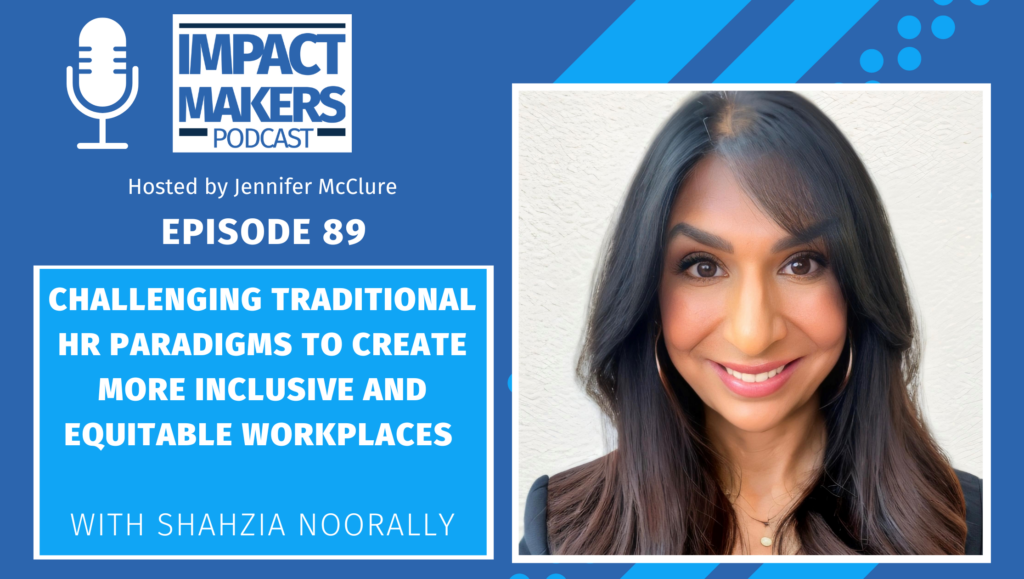
Challenging Traditional HR Paradigms to Create More Inclusive and Equitable Workplaces With Shahzia Noorally

On episode 89 of the Impact Makers podcast, I chat with Shahzia Noorally, a Diversity, Equity & Inclusion practitioner, Speaker, and podcast host.

With her dynamic voice, Shahzia is changing the narrative around workplace authority and equity. In our enlightening conversation, she shares her inspiring journey from a place of isolation in her first leadership role, to becoming a passionate advocate for equity within the utilities industry and beyond. Her unique insights are shaped by her experiences as a woman of color, a child of immigrants, and an HR practitioner.

Our conversation takes us through the challenges and biases that persist in traditional leadership and mentorship models, and we also explore the concept of sponsorship, which can create a space for authentic expression, amplifying not just talent but also the voices that often go unheard.

I first met Shahzia when we were both speaking at a DisruptHR Calgary event back in 2019 and have been following her and her work since that time. I find her to be insightful and purposeful, and I really appreciate how she approaches equitable work and workplaces through a lens of possibilities rather than challenges, and a purpose that is rooted in influencing a more just-world.

Outside of her work, Shahzia hosts The Equity Gap podcast, and she leans into community, anchoring her energy towards amplifying Black, Indigenous and women of color to show up in the world, and take up all the space that they desire and deserve.

I think you’ll enjoy learning from Shahzia in our conversation, and I encourage you to share this podcast with others in your network who may benefit from rethinking some of our traditional approaches to Diversity, Equity, and Inclusion in the workplace.

Topics Discussed In Today’s Episode:

  • The challenges of relying solely on the concept of “diversity of thought” and why demographic representation is vital.
  • Why current leadership models need rethinking to encourage individual authenticity instead of molding individuals to fit pre-existing molds.
  • How sponsorship stands apart from traditional mentorship and can be more helpful in addressing systemic barriers faced especially by BIPOC.
  • Why modern workplaces must adapt to become inclusive, ensuring everyone has equal access to influence, and challenging traditional white male-centric leadership models.
  • The broader implications related to equity that extend well beyond equal pay.
  • The importance of optimism in addressing diversity and inclusion challenges with an open mind and proactive attitude.
  • Why a paradigm shift from a one-size-fits-all approach in HR practices to one that centers the experiences of the most marginalized employees is necessary, and how that can lead to broader benefits for all.

LISTEN TO IMPACT MAKERS PODCAST – EPISODE 89

Listen on Apple podcasts, Google podcasts or Spotify

People & Resources Mentioned In This episode:

Shahzia Noorally – LinkedIn, Website, Instagram

The Equity Gap podcast – On Apple Podcasts, LinkedIn, Instagram

HR, We Have A Problem | Susy Ko & Shahzia Noorally | DisruptHR Talks

Do You Know the Reference Man? | Shahzia Noorally | DisruptHR Talks

Rethinking podcast with Adam Grant: Finding–and becoming–great mentors and sponsors with Carla Harris

The Equity Gap podcast: From saviorism to solidarity in the workplace – a conversation with Dr. Golnaz Golnaraghi – Changemaker, Speaker, Author & Founder of Accelerate her Future

Accelerate Her Future

Categories: Blog, Diversity Equity and Inclusion, Podcast
Posted on August 29, 2023

Written by Jennifer McClure

How to Deliver a Killer Presentation: Avoid These 5 Common Mistakes

I make my living as a professional communicator, which means I have the honor of speaking to audiences at conferences, association meetings, and corporate events all over the world.

One of the benefits that I truly enjoy when speaking at events is attending other keynotes, breakout sessions, or workshops whenever possible. I’m always interested in learning, and I also want to watch great speakers in action, so I can continue to grow and improve my speaking skills as well.

At a recent conference, I chose to attend a breakout session led by a speaker with an impressive title. His bio listed many professional accomplishments and years of experience in a topic that I was very interested in learning more about. Even though his session was scheduled a few hours before my closing keynote, I made a point to get to the convention center early in order to take advantage of the opportunity to learn from him.

Unfortunately, very quickly into the 75-minute session, it became clear that learning was going to be a challenge. Even though his professional experience and accomplishments related to the subject were impressive, the speaker conveyed zero excitement or passion for the findings of the case studies and research that he shared, and he didn’t seem to care at all about connecting with the audience.

Pretty soon, in an effort to salvage my time investment, my note taking shifted towards capturing quotes and actions from the speaker that affected my ability to learn from him.

10 Audience Engagement Killers

  1. “I’m not going to bore you with that…”
  2. “We don’t have time to talk about that today…”
  3. “What time is it?”
  4. “Here’s a picture of an article I wrote in 2008…”
  5. “I’m not going to go through each one of these…”
  6. “How much time do I have left?”
  7. “There are a variety of reasons for this, we just don’t have time to talk about them here…”
  8. “I’m not going to go into this, it’s too involved for this gig…”
  9. “Am I still okay on time?”
  10. “This slide shows a whole bunch of reports which focus on financial metrics. Blah, blah, blah, blah…”

The 10 statements above were exact quotes from the speaker during this session – even number ten.

Unfortunately, I left the session frustrated, because myself – and about 150 others – had wasted 75 minutes of our time. We had met the speaker’s expectations of not being able to understand or take action on the information presented, but he did not meet my expectations as an audience member – which is for the speaker to provide value.

I can guarantee you that no meeting planner plans for their audience to leave a session having learned nothing new or at least challenged to try something new – and no speaker should either.

As someone who has been speaking on stages for over 15 years, I know that speaking in front of any size of audience can be tough on the ego. Even when I feel that I’ve knocked it out of the park, there is always someone in the audience who didn’t connect with my material, or who didn’t care for my delivery.

But I also know that I can increase the odds that my message will connect with the majority of audience members if I can answer the following question:

“What do I want the audience to DO with this information following my presentation?”

Once I have the answer to that question, I then need to care enough to use the time that I’ve been given to help the audience to understand why and how it’s possible for them to do just that.

Successful speakers care about the audience and their learning experience.

If you’ve been selected or appointed to speak in front of an audience – you’ve been given the valuable gift of people’s time. Whether it’s a keynote in front of thousands, a DisruptHR Talk, or a presentation to your team in a conference room, you can show your audience respect and appreciation by never making the following mistakes as a speaker:

5 Mistakes Successful Speakers Never Make

1. Never show, mention, or refer to something the audience cannot see clearly on the screen.

Examples: “I know this is an eye chart, but…” or “You can’t see this, but let me tell you what it says…”

2. Never show a statistic, reference a study, or display a quote without also sharing the source.

Who said this? When was it? How can I follow up to learn more? <- What your audience is thinking.

3. Never include stats, studies, or reference material on a slide that is more than 2 years old.

If your idea or premise is based upon 10-year-old research, find (or create) new research to support it.

4. Never refer to your own presentation materials, content or speaking style as boring.

Don’t plant seeds that you don’t want to grow. If the audience wasn’t already thinking that – they surely are now.

5. Never ask how much time is left for your presentation.

Asking the audience about time remaining shows a lack of preparation – and implies that you plan to fill the allotted time – no matter what. Bring a clock, use a time app on your phone, or have a friend hold up a sign to keep track of time – but never ask the audience to do it for you!

Any presentation that you create and deliver should be with the goal of educating, informing, encouraging and inspiring your audience. They’ll love you for it – and maybe they’ll even say something nice about it afterwards!


Do you want to build your personal brand and share your expertise as a speaker?

Download my free guide today: 10 Tips to Build Your Brand and Land Gigs as a Speaker – to discover how!

The guide includes links and examples of how successful speakers are marketing themselves using online and offline tactics and strategies.

Categories: Blog, Effective Communication, Speaking
Posted on August 22, 2023

Written by Jennifer McClure

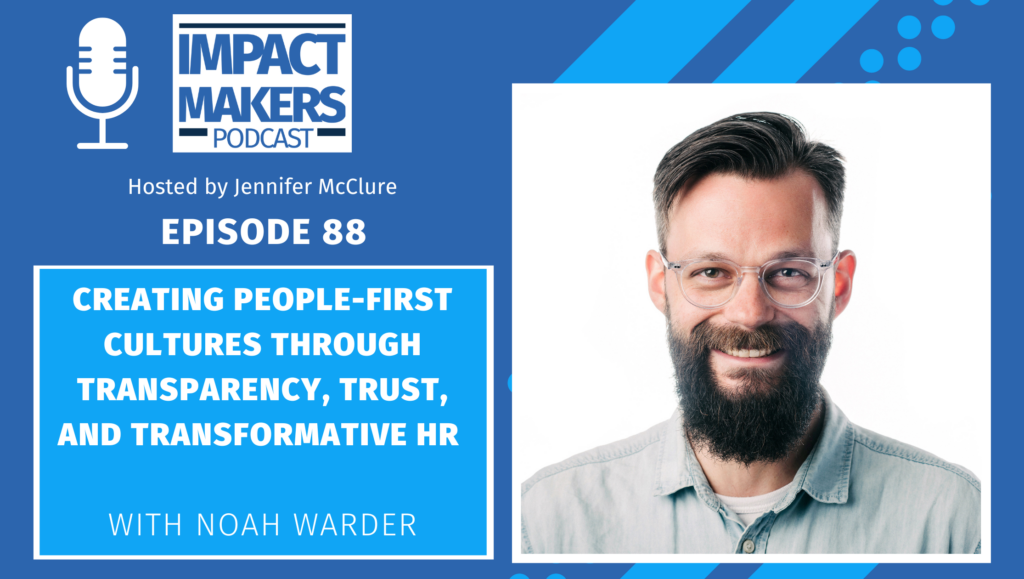
Creating People-First Cultures Through Transparency, Trust, and Transformative HR With Noah Warder

Get ready to reshape your HR practices with my guest on episode 88 of the Impact Makers podcast – Noah Warder!

Noah has been leading people teams across Canada and the US for over 10 years, and now leads the People Team at Guusto, a company that provides a recognition and rewards platform focused on both front-line and office employees. In this role, he gets to marry his passion for building a people-first culture that focuses on creating purpose, opportunity, and well-being for every member of Guusto team.

He’s also the Principal Consultant and Founder of PeopleOps Consulting, where he helps early-stage Founders to build people-first cultures in rapidly growing organizations, and he brings a fresh perspective to the role HR should play in advocating for a culture that stimulates open dialogue and forethought.

In our conversation on the podcast, Noah shares his thoughts on how to balance daily tasks and strategic initiatives while also debunking the misconception that effective people practices need to be intricate or costly. We also chat about the vital role of diverse leadership teams in recruiting a diverse workforce, and the significance of tying DE&I strategies to business objectives.

Finally, Noah share his views on trust-building within HR, and his strategies for providing constructive feedback, including the challenge of communicating with those skeptical of HR.  He firmly believes that transparency in leadership leads to more openness and clear communication that can empower employees and foster greater engagement.

I think that you’ll enjoy our conversation, and will leave it with some actionable takeaways to create, or further build a people-first approach in your own workplace.

Topics Discussed in Today’s Episode:

  • Why HR leaders should get more comfortable with starting small, making mistakes, and avoiding perfectionism.
  • Strategies for prioritizing people initiatives when HR leaders have so much on their plates.
  • How to approach making a business case for important people strategies when the ROI is hard to quantify.
  • The importance of building influence and trust as a people leader, in order to get things done.
  • Why it’s important – and healthy – to embrace conflict in order to reach better outcomes.
  • Why transparency is so important for company culture and trust in organizations.
  • The importance of being intentional about adding diverse voices and perspectives to the people you listen to, follow and learn from.
  • Suggested communities and resources for people leaders to share ideas and best practices, and gain support from others facing similar challenges.

LISTEN TO IMPACT MAKERS PODCAST – EPISODE 88

Listen on Apple podcasts, Google podcasts or Spotify

People & Resources Mentioned in This episode:

Noah Warder – LinkedIn: https://www.linkedin.com/in/noahwarder/

Noah Warder – Twitter: https://twitter.com/NoahWarder

PeopleOps Consulting – https://www.peopleopsconsulting.com/

Guusto – https://guusto.com/

Lars Schmidt – LinkedIn: https://www.linkedin.com/in/larsschmidt

Amplify Academy – https://amplifytalent.com/academy

ChartHop People Ops Community – https://www.charthop.com/the-people-ops-community/

The People People Group – https://thepeoplepeoplegroup.com/

Categories: Blog, Diversity Equity and Inclusion, Human Resources, Leadership, Podcast
Posted on August 21, 2023

Written by Jennifer McClure

Hiring for Success: An Interviewer’s Guide to Identifying Job Fit and Future Potential

Recently, for a student research project, I was asked to provide my thoughts on the skills that I believe are essential for young professionals entering the workforce, as well as how I would assess these skills in internal or external job applicants.

Below are the questions that were asked of me, as well as my responses.

Question 1: What specific knowledge, skills, and abilities do you look for in new applicants?

Generally, I look for curiosity, communication skills, problem-solving ability, and a desire to learn and grow. If an applicant has these skills and abilities, then they can be developed, and can grow into a variety of roles over time.

Specifically, I would also look for basic qualifications and experience to do the specific job that they’re applying for. Unless it’s a truly entry level position, ideally, they will have some education, volunteer experience, or work experience related to the job that they can demonstrate through results they’ve previously been able to achieve.

When interviewing, I’m always interested in hearing from applicants how they improved something in a previous or current role, and how they approached specific challenges or assignments. I want to be able to understand how they’re oriented towards solving problems, taking on challenges, and pushing through resistance.

Question 2: Which of these knowledge, skills, and abilities do you think are the most important for candidates to have, in order to advance in their career?

I place a priority on a candidate’s desire to learn and grow, and curiosity to seek out opportunities or problems/challenges that need to be solved in order for the company to successfully achieve its goals.

I want to understand if they’re intellectually curious enough to ask great questions in order to understand the current state/desired state? Also, do they seek out growth opportunities?

Question 3: What factors are considered more heavily in the hiring process – previous experiences, qualifications, or an applicant’s performance during the interview?

The answer to that question will depend upon the position level that I’m hiring for.

For entry level positions, I would focus more on the interview, education and qualifications, but as mentioned above, I’d be looking more for learning ability, curiosity, and growth orientation.

For mid-level or senior roles, previous work experience is going to weigh more heavily, but I would also be looking for the same things that I do with entry-level folks. However, I’d be asking candidates to share specific examples of how they’ve demonstrated the skills required in the job in one or more of their previous roles or life experiences.

Question 4: How does utilizing past experiences and examples from their work history help candidates to address difficult interview questions and demonstrate qualifications for a role?

I believe that it’s critical for interviewees to have some examples prepared in advance to show how they’ve demonstrated specific skills or abilities in their past jobs, education, or volunteer experiences, as well as how they have gotten results. A Career Coach I worked with once called these CAR (Challenge / Action/ Result) stories, and I’ve also heard them called STAR (Situation / Task / Action / Result) stories.

If an applicant prepares several examples from their experience that they can put into one of these frameworks prior to interviews, then they can be utilized to effectively answer many behavioral interview type questions – those “Tell me about a time when…” questions.

As an interviewer, when I ask a behavioral interview question, I’m not necessarily interested in the actual story the person is telling me as a response. I’m looking to understand their thinking process, how they approach challenges or responsibilities, how they respond when things don’t go as planned, how they involve others, etc. If the end result is a win, that’s great, but I think there are also good stories that can be shared where the end result wasn’t what was expected or hoped for, but the applicant can work in what they learned from the “failure”, and how they approached recovering from the failure in order to achieve the desired results.

—

Obviously, a good interview requires much more in-depth discussion and questioning, but in general, for the purpose of this study, I tried to sum up some of the key skills to look for in candidates that I believe make the best hires for not only the current job opening the candidate is being considered for, but also to have the best chance for future growth and success with the company.

___________________________

As a keynote speaker and leadership coach, Jennifer McClure helps leaders to embrace the future of work, and to develop the skills necessary to lead their organizations and the people on their teams to take bold actions that positively impact business results.

Want more leadership and future of work insights from me?

SUBSCRIBE to get my weekly Impact Makers newsletter delivered to your inbox!
Categories: Blog, Interviewing
Posted on August 15, 2023

  • 1
  • 2
  • Next Page »

Recent Posts

  • Why HR Should Be the Chief Disruption Officer in Every Organization
  • Mastering the Art of Virtual Networking: 5 Steps to Build Powerful Connections Online
  • Networking for Introverts: Practical Strategies for Building Meaningful Connections with Greg Roche
  • Leading with Vulnerability: The Key to Future-Ready Leadership with Jacob Morgan
  • Future Fluidity and the Evolving Role of Leadership in the Age of Disruption With Dr. Tanvi Gautam

Categories

Archives

Need A Speaker?

I've delivered keynotes and led workshops at over 350 conferences and corporate events.

If you want to check my availability for your event, or if you have questions, click below.

Start the Conversation »

Recent Blog Posts

  • Why HR Should Be the Chief Disruption Officer in Every Organization
  • Mastering the Art of Virtual Networking: 5 Steps to Build Powerful Connections Online
  • Networking for Introverts: Practical Strategies for Building Meaningful Connections with Greg Roche
  • Leading with Vulnerability: The Key to Future-Ready Leadership with Jacob Morgan
  • Future Fluidity and the Evolving Role of Leadership in the Age of Disruption With Dr. Tanvi Gautam

Connect on Social

  • Facebook
  • Instagram
  • LinkedIn
  • Twitter
  • Vimeo

Copyright © 2026 · Jennifer McClure · Privacy Policy

Copyright © 2026 · McClure Pro on Genesis Framework · WordPress · Log in