Jennifer McClure`

Equipping people leaders to navigate change — and design the future — with boldness and purpose.

  • About
  • Speaking
  • Schedule
  • Blog
  • Impact Makers Podcast
  • Contact

Written by Jennifer McClure

Can an Internal Coach or HR Pro Be Trusted With Your Secrets?


At The Conference Board’s Executive Coaching Conference
that I recently attended, we spent some time in one of the sessions discussing concerns with HR pros being designated or trained as
internal coaches in organizations due to trust and credibility issues. (Note: attendees at the conference were primarily external coaches and OD professionals.)

Here’s a tweet I sent out during the discussion:
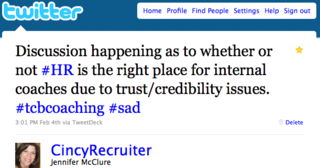
TCB Coaching tweet

I guess the discussion made me a bit #sad because as a former Human Resources pro myself, I felt like I was effective as an internal “coach”. Whether working with an employee as part of their career development process or providing support to some making it through performance improvement plans, I worked hard to balance their need for confidentiality in the process with my responsibilities to the organization. I took pride in being someone that employees at all levels could talk to and one CEO even referred to me as his Consigliere – which considering some of the bullets I took for him, was kind of fitting.

But I do recall a conversation I had one day with an employee who was experiencing some issues at work. When I offered to listen and provide support, she said “Unfortunately, I can’t talk to you about this. It’s not that I don’t trust you personally. It’s the chair that you sit in. You have the authority to fire me. And I can’t risk that.”

After she left my office, I thought about what she’d said. I wanted to be offended. But I kinda understood where she was coming from. While it was frustrating that she wouldn’t allow me to try to help out just because of my position in the organization, I also knew that sometimes it was part of my role to be involved in making decisions about her career. So sharing a weakness or performance problem with someone who has that type of influence could be perceived as a risk.

Fast forward to today, where I work with clients as an external Executive Coach… The feedback I’ve received from clients is that one of the most helpful aspects of the coaching process is the opportunity to speak confidentially with someone outside of the organization who can listen, support, challenge and guide them. I’ve listened as senior level clients have shared with me a variety of potentially career damaging things – being afraid of making decisions, that they’re intimidated by a peer or they’re unhappy in their jobs. We’ve been able to work through and resolve those issues, but I’ve often wondered if it would be a challenge for me as an internal coach to have access to that same information.

HR often seems to get thrown under the bus in regards to confidentiality and credibility issues (if you’re the one causing that to happen, then please STOP), but I don’t agree that credibility/trust of internal coaches is an “HR” issue. I think it’s more about the perceived confidentiality that an external coach can provide – no matter how good an internal coach may be.

I think it’s hard for employees not to feel at risk when sharing information with people in a position to influence their careers.

What do you think? Can HR pros serve as effective coaches inside their organizations? Do external coaches have an advantage over internals?

The conversation at the conference has caused me to wonder if maybe the employee who was preoccupied with where I parked my derriere each day was on to something…


Categories: Blog, Executive Coaching, Human Resources
Posted on March 4, 2010

Written by Jennifer McClure

2 Secrets of Successful “Social Recruiting” Explained

Every day, somewhere out there in our universe, many Recruiters are losing their way in regards to using social networks such as LinkedIn, Twitter and Facebook for recruiting purposes. I see the complaints (often ironically aired via Twitter) that <insert favorite social network name> simply doesn't work for recruiting and is only a waste of time. These rants are typically followed by statements extolling the virtues of the telephone – and how "real" Recruiters know how to magically work this ancient device. And I sigh.

<Sigh>

And I continue to think that they're not willing to evolve and learn how to use these tools successfully. 

*

Recently, I came across two great examples that explain how I believe Recruiters should approach social networks for recruiting purposes. The first is from Amber Naslund, who writes the consistently informative Altitude Branding blog. In her post – How I Made $100k With Twitter – Amber shares 8 steps she took to make money using Twitter to build relationships and market her services. Be sure to check out the full post here.

In the excerpt below, I've taken the liberty of inserting recruiting-related terms to illustrate how I think the method Amber outlined is exactly the way to approach using Twitter (and other social networks) for recruiting.

The magic in making money <recruiting> with social media isn’t that the site or
social network becomes a revenue center <candidate database> itself. I didn’t sell stuff <"recruit"> on
Twitter. I gave people access to me and my expertise, and paid
attention to when the time might be right to talk business
<about opportunities at my company>.

That’s the trick here, folks. Social media is rarely the cash
register <candidate Fairy>. It’s communication tools that help form the foundation for
healthy business relationships that might eventually lead to sales
<successful placements> elsewhere. Whether you’re B2B or B2C.

Twitter was just the handshake that got the conversation started. It
required an investment of time and effort for me to spend time there
and converse
without the intent to sell something <recruit anyone>, and lay
the groundwork for trust and relationships. Much like having lunch or
going to networking events. I spent time getting to know the people
that might eventually be the decision maker for a project that I could
be hired for <the potential clients or perfect candidates for positions I'm recruiting for>. And when they needed something like what I did, they
often thought of me.

It’s that simple, and yet that complex.

Nailed it. To me, that's one of the simplest and best explanations that I've seen regarding how relationships are developed, business connections are made and successful recruiting is done via social media.

*

Second, Andy Headworth of one of my favorite recruiting blogs – Sirona Says – interviewed Super Sourcer/Recruiting Trainer/Social Media Whiz Kid Jim Stroud at the recent TruLondon Unconference asking – "Where will social media recruitment be in 2 years?" Jim didn't disappoint, giving an interesting and insightful answer. (Email subscribers will need to click through to the blog to view the video)


Hint: It's not about being able to find more people folks.

*

I think we've got to get more people thinking differently about how to use social networks for recruiting purposes. It's more about relationships and branding and less about having a large network or being able to find names.

What do you think? Do you think investing the time to build relationships and to establish a "personal brand" on social networks is required to successfully recruit? Or is the "old way" still the best way?

Categories: Blog, Recruiting
Posted on February 25, 2010

Written by Jennifer McClure

Executive Coaching: What Are Global Coaching Leaders Discussing?

The-Conference-Board Recently, at the invitation of The Conference Board *, I had the opportunity to attend their 2010 Executive Coaching Conference in New York City. As an Executive Coach, I was thrilled to be able to attend this event and learn from some leading coaches and global organizations about best practices and current trends. Today’s post is the first in a series where I’ll share some of my experiences, takeaways and observations from the conference.

Below is an overview of my experience at the Executive Coaching Conference via take-aways and quotes from the speakers that I shared on Twitter using the hashtag #tcbcoaching. (Also included are some tweets from fellow conference blogger Barry Zweibel of GottaGettaCoach! Incorporated). During the conference, there were a number of great points made about internal & external coaches, measuring ROI of coaching and some interesting potential future applications were discussed (texting & Second Life).

Please forgive the abbreviations and shortened words in some tweets due to the 140 character limit!

Conference Keynote (Marshall Goldsmith – Author & Executive Educator)

  • Check out @coachgoldsmith‘s new book at www.MojotheBook.com – came out this past Tuesday.
  • Tons of FREE resources for Coaches and Leaders at http://marshallgoldsmithlibrary.com
  • Good job interview question @coachgoldsmith recommends: “Do you love what you do?
  • Best coaching advice: Imagine you’re dying & you have the ability to go back & talk to yourself. What advice would you have?

Peak Personal Performance Session

  • 4 sources of energy – all critically important: Purpose (direction) Physical (quantity) Emotional (quality) Mental (focus)
  • “Strategic disengagement” – new way to say “take some rest”.
  • There are 20,000 moments in every day where you can make a difference. Are you an Eeyore or a Tigger?
  • Research shows that having an “attitude of gratitude” can add 5 years to your life.
  • “The only difference between a rut and a grave are the dimensions.” Important to keep moving forward and stay sharp.
  • Powerful things: 1) Craft a Purpose Statement 2) Get clear on Ur Top 5 Roles in Life 3) Define 100 Things U Want to Do in Life
  • 80% of heart attack victims never change their behavior. 20% that do? They have someone who holds them accountable for change.
  • It takes 21 days to establish a new habit. Invest extraordinary energy in it during that time & build in accountability.

Keynote: The Role of Virtual Coaching – Pros and Cons

  • “No correlation between fees that are charged and the Quality of coaching you get”
  • So true: “If you know where the conversation is going… It’s not Coaching”
  • “Really good coach helps redefine a clients goals” (via @ggci)
  • “The more detail you put into a definition, the less meaningful it likely is” (via @ggci)
  • Most coaches are under qualified – even those chosen by the executive (via @ggci)
  • “To be an effective telephone-based coach, you need to first be a good in-person and via-email coach” (via @ggci)
  • Case study done on an instance of Coaching by text. Hmmm… does it make me old-fashioned if I don’t think that’ll work?
  • Levels of coaching – skills, performance, behavioral, transformational (via @ggci)
  • Clutterbuck suggests not dismissing Second Life in terms of coaching either.
  • A broad sense of purpose has a higher correlation to success than goals. Goals are an outcome of your Purpose.
  • Important in Coach/Coachee relationship to have enough similarity to create rapport, but enough difference to create stretch

2009 Executive Coaching Practice Survey (results overview)

  • Exec Coaching survey: In large orgs, most resp 4 coaching are managed centrally re: strategy. Local takes active role in matching
  • Average length of coaching engagements (external coaches) – majority in 6 – 9 month range, very few lasting longer than 1 yr.
  • Survey: Majority (50%) of large orgs work with external coaches who have 1 – 5 coaching engagements in their orgs per year.
  • Survey: #1 reason for engaging an external coach – Development. 2nd 360 Debrief. 3rd Other assessment debrief. 4th Transition
  • Survey: Majority of coaches (0ver 50%) are paid as services are rendered or monthly. Only 2.8% are paid at end of engagement.
  • Survey: Internal coaching is on the rise and growing, but in its infancy. Internal coaches tend to be HR prof vs line leaders.
  • Survey: Almost 80% of internal coaches spend less than 20% of their time on coaching activities.
  • Discussion happening as to whether or not #HR is the right place for internal coaches due to trust/credibility issues. #sad
  • “Line business leaders trained as coaches have double the credibility – because they know the business” #HRopportunity

How Coaching Is Being Used With High Potentials (Panel)

  • Panelist: It’s more important for external Coaches to focus on gaining experience & strong reputation vs specific certification.
  • At Amex, coaching evolving into high-touch, targeted investment closely linked to business results. (via @ggci)
  • At NY Life, coaching is about culture change, and creating ‘distributed’ and ‘principles-based’ leadership (via @ggci)
  • At Microsoft, coaching program “allows emerging and experienced leaders to learn from each other.” (via @ggci)
  • At Microsoft, coaching dev plans include more observing/interacting w/senior leaders; building strong networks w/other hi-pos (via @ggci)
  • At Amex, “coaching must leave a footprint in the organization that builds our internal capability” (via @ggci)

Identifying & Developing Coaching Competencies for Managers (Panel)

  • Very cool job – panelist at #tcbcoaching = Coach at NASA. Challenge of getting highly technical folks to understand “art” of leadership

It’s a wrap!

  • Finishing up at The Conference Board’s Executive Coaching Conference #tcbcoaching. Top notch event with sharp speakers/attendees. Good info!

* Disclosure: By accepting TCB’s invitation to attend, I’m asked only to help them get the word out about their events and the programs that they offer to leading organizations and senior executives. I’m free to share my opinions (positive or negative) about my experience in attending and comment on the content shared by the speakers at the conference.

Categories: Blog, Executive Coaching, Leadership
Posted on February 22, 2010

Written by Jennifer McClure

The Best Lists? The Ones You Make! (Top 25 Most Influential Online Recruiters)

Top25-hr-digital-recruiters-logo Today, John Sumser and the good folks over at HR Examiner have unveiled their latest list of Online Influencers – the Top 25 Most Influential Online Recruiters – and apparently somebody left the back door open, because yours truly somehow managed to sneak in!

<insert massively awkward happy dance>

Hey I know it’s just another list, and there are always more people left off of any list that should be on it than there are actually on it (and I can think of several folks I would say are missing from this one) – but like any awards show nominee will tell you, it’s still nice to be included.

The HR Examiner uses an online reputation discovery tool – Traackr – to measure reach, relevance and resonance in the online world in an effort to keep their lists objective and this one follows the announcement of the Top 25 HR Digital Influencers 2009 released this past December.

I’m honored to be included on any list along with the likes of Sumser, Steckerl and Sullivan – widely recognized recruiting thought leaders and influencers that I’ve followed and learned from for many years.

Thank you very much HR Examiner and a huge congratulations to everyone that is mentioned!

Categories: Blog, Recruiting
Posted on February 19, 2010

Written by Jennifer McClure

Passion: It’s Not a Dirty Word in HR !!

In the wild world of HR, I come across many HR people who either hate the profession or feel that everyone hates them.

Passion - It's Not A Dirty Word In HR

There are blog posts about the death of HR.  Magazines love to fill themselves with how the profession is failing.

Today’s guest post is from my good friend and mentor Steve Browne, who is Executive Director of Human Resources at LaRosa’s, Inc. a regional Pizzeria restaurant chain employing over 1,400 Team Members. Being passionate about HR is a subject that Steve is uniquely qualified to talk about – because that’s how he’s consistently described by others. Learn more about Steve at the bottom of this awesome post.

HR is tough. It is.

That’s because we have to deal with people and people are tough. However, that’s also the BEST reason to be in HR! Seriously. The main reason I went into HR was to mess with people. Trust me. It’s allowed.

When it comes to “passion”, some people tend to think that it’s not appropriate in the work environment. Unfortunately, because many people aren’t passionate at work, they often feel disillusioned and are thinking about how to leave their employer more than they’re seeking how to drive performance.

The reason the TV shows “The Office” and “30 Rock” are so popular is because people know folks that work beside them who are reflected in the characters of the shows.

People who love what they do scare us too! Really. People who are passionate are often under suspicion of not being genuine or just a cheerleader who doesn’t have a clue. That’s sad. We’ve come to a point in work environments where drudgery is often preferred to enjoying what you do! Think about that.

HR, more often than not, is the catalyst of this drudgery because they don’t see the ability, or avenue, to be passionate at work. This needs to change! HR professionals have to ask themselves – “If this is so bad, then why am I doing it”?

HR people who aren’t passionate should get out of HR.

Sounds harsh – but it would be better for you and the profession if you went into a field you were passionate about.

So can you be passionate about HR these days ? The answer is a resounding YES! Here’s how:

1)       JUMP IN OVER YOUR HEAD

Get away from your desk and into your people. Your desk doesn’t miss you as much as you think it does. Your people do.

Too often HR’s answer to people is – “I’ll get back to you” – when we never intend to do it. Stop this! Get in front of your employees and let them know that they do exist, they’re valuable and that you (and the company) appreciate what they do.

2)      BE CONSISTENT

Get out of the fairness and compliance mode. Compliance is the law. We can’t change laws, so quit trying to.

Be consistent with how you handle situations and understand that the majority of what we do is gray and not black and white. Consistency is essential and people will see how “fair” you really are when you’re consistent.

3)      BE GENUINE

Who likes fake people? Anyone? You can’t teach this. You either are genuine or you aren’t. And your employees know it right away.

If you knew me and saw my office, you’d hear my iPod blaring, and see my lava lamp bubbling next to my Magic 8 Ball and the sword on my wall. I also just got a bobble head made of myself! (A gift from a vendor.) I only wish it was a tie dye shirt versus a blue oxford!

I’m passionate about everything I do. Honestly. More often than not people respond to this positively and most of them say that HR at our company is better because this is the tone that HR sets:

Love what we do and what you do!

Give it a try. Passion is awesome! Passion is critical! And – HR MUST be passionate !! – @sbrownehr

———-

Steve Browne bobble head Steve Browne, SPHR is an HR pro who is passionate about connecting people. He runs an internet message board (the HR Net) – with over 7,500 global subscribers – and enthusiastically facilitates monthly HR Roundtable meetings in Cincinnati. Steve actively serves on the SHRM Board of Directors, and is a popular speaker at HR Conferences, HR Associations and business/community groups.

Want to be a part of the HR Net? Let Steve know! Follow him on Twitter at @sbrownehr.

Categories: Blog, Human Resources
Posted on February 15, 2010

  • « Previous Page
  • 1
  • …
  • 35
  • 36
  • 37
  • 38
  • 39
  • …
  • 48
  • Next Page »

Recent Posts

  • Why HR Should Be the Chief Disruption Officer in Every Organization
  • Mastering the Art of Virtual Networking: 5 Steps to Build Powerful Connections Online
  • Networking for Introverts: Practical Strategies for Building Meaningful Connections with Greg Roche
  • Leading with Vulnerability: The Key to Future-Ready Leadership with Jacob Morgan
  • Future Fluidity and the Evolving Role of Leadership in the Age of Disruption With Dr. Tanvi Gautam

Categories

Archives

Need A Speaker?

I've delivered keynotes and led workshops at over 350 conferences and corporate events.

If you want to check my availability for your event, or if you have questions, click below.

Start the Conversation »

Recent Blog Posts

  • Why HR Should Be the Chief Disruption Officer in Every Organization
  • Mastering the Art of Virtual Networking: 5 Steps to Build Powerful Connections Online
  • Networking for Introverts: Practical Strategies for Building Meaningful Connections with Greg Roche
  • Leading with Vulnerability: The Key to Future-Ready Leadership with Jacob Morgan
  • Future Fluidity and the Evolving Role of Leadership in the Age of Disruption With Dr. Tanvi Gautam

Connect on Social

  • Facebook
  • Instagram
  • LinkedIn
  • Twitter
  • Vimeo

Copyright © 2026 · Jennifer McClure · Privacy Policy

Copyright © 2026 · McClure Pro on Genesis Framework · WordPress · Log in