Jennifer McClure`

Equipping people leaders to navigate change — and design the future — with boldness and purpose.

  • About
  • Speaking
  • Schedule
  • Blog
  • Impact Makers Podcast
  • Contact

Written by Jennifer McClure

Best Practices In Recruiting With Social Media [Slideshare]

This Fall, I’ve had the pleasure of attending and speaking at five State SHRM Conferences (Illinois, Florida, Indiana, Colorado & Minnesota) about the topic “Using Social Media for HR & Recruiting” – and I’ve enjoyed every minute of it! I’m so excited to see continued and growing interest and enthusiasm from human resources & recruiting pros around learning more about how to utilize social media as part of their day-to-day activites.

To address that growing interest, a couple of the conferences I’ve attended – Illinois & Colorado – scheduled a full day of social media related sessions with presenters covering the topic from a variety of angles (including HR, recruiting, legal, usage by unions, etc.).

Last week, I spoke a the Minnesota SHRM Conference, and they included two day’s worth of social media offerings! On Day 1, I presented two sessions – “Using Social Media in HR: Attract, Recruit, Retain” and “Best Practices In Recruiting With Social Media” and my friend and favorite @MNHeadhunter – Paul DeBettignies – took over on Day 2, covering “Rocking LinkedIn: Profiles, Connections, Sourcing & Recruiting” and “Social Media for Recruiting: Let’s Get Doing”.

I thought I’d share my slide deck for the “Best Practices In Recruiting With Social Media” session in an effort to highlight some of the Minnesota employers (plus a few others) whom I believe are doing some cool and interesting things with their use of social media for recruiting and employment branding.

Best Practices In Recruiting With Social Media 10 2011

View more presentations from Jennifer McClure

Highlighted Companies:

Careers Site:
Best Buy
UnitedHealth Group
The Nerdery

Facebook:
General Mills Careers
The Nerdery

YouTube:
UnitedHealth Group
Mayo Clinic

Blog:
Daxko Nation
EMC Corporation Community
Lisa Rosendahl blog (one of my favorite Minnesota HR pros)

Twitter:
General Mills

LinkedIn:
Deluxe Corporation Company Profile
Sodexo Careers Group

*

The companies listed above are just a few of the ones that I often highlight in many of my presentations.

What other companies would you suggest that are really innovative in utilizing social media with their HR, recruiting and/or employment branding efforts? Share some examples with us in the comments section!

Categories: Blog, Employment Branding, Presentations, Social Recruiting
Posted on October 7, 2011

Written by Jennifer McClure

The Conference Board’s Senior HR Executive Conference [Discount Code]

As I’ve said before, I love attending events put on by the folks at The Conference Board. Their conferences and events always feature top-notch quality speakers from leading companies, great content and some great networking opportunities!

The good news is that I have the opportunity to attend another Conference Board event this year – The Senior HR Executive Conference – on November 15th and 16th in New York City – and the even better news is that I’ve got a Discount Code for you if you’d like to attend too.

Enter the Discount Code “JM1” when registering and you’ll save $500 off of the registration price!

The Senior HR Executive Conference will be held at the New York Marriott Dowtown and the focus of the conference is – “The Future of Work: Growth, Innovation & People.

Details from the conference website and scheduled speakers include:

In spite of the recent negative economic news, growth and innovation remain critically important.  In fact, now more than ever, companies must continue to focus growth through innovation to remain competitive. At the heart of that agenda is the workforce, getting the right people in place, the right culture to grow and innovate. The 2011 Senior HR Executive Conference is a must attend event for all HR professionals. This year the conference has been extended with specialized breakout sessions on each day to add breadth and depth to the event, featuring:

  • Expanded content – two full days of sessions which include two afternoons of tracked, highly interactive sessions, focusing on Management & Process, Issues & Strategies and Talent & Leadership
  • Insights from world-class companies on developing a workforce that is productive, innovative and engaged
  • Keynote sessions and CHRO panels focused on innovation and talent, leadership, global growth and the future of the organization
  • Facilitated, interactive, improvisational workshops on how to think different, lead and collaborate

Confirmed Speakers Include:

Archana Singh, Corporate Vice President, AMD
Steve Hinden, Vice President, Executive Compensation, American Express
Shirley Gaufin, Chief Human Resources Officer, Black & Veatch
Lynne Oldham, Head of Human Resources, North America, BNP Paribas
Richard Stephens, Senior Vice President, Human Resources and Administration, The Boeing Company
Rosalyn Taylor O’Neale, Vice President, Chief Diversity & Inclusion Officer, Campbell Soup Company
Bill Adams, Senior Faculty, Center for Creative Leadership
Brenda Dennis, Strategy and Planning, Cisco
Tana Cashion, Vice President, Human Resources, Devon Energy Corporation
Nadia Owens, Vice President, Total Rewards, DIAGEO
Judith Edge, Corporate Vice President, Human Resources, FedEx Corporation
Glenn Gilkey, Senior Vice President of Human Resources, Fluor Corporation
Nicholas Garbis, Strategic Workforce Planning Leader, GE Energy Global Strategy and Planning
Jared Lucas, Director, Human Resources, LinkedIn
Tanya Srepel, Vice President, Human Resources, Strategies and Global Initiatives, General Mills
Caroline Stockdale, Senior Vice President and CHRO, Medtronic Inc.
Patricia Milligan, President, Human Capital, Mercer
Brian Kelly, Partner, Mercer
Monique Matheson, Vice President, Human Resources, North America, Nike
Johnna Torsone, Executive Vice President and Chief Human Resources Officer, Pitney Bowes
Paul Salvatore, Co-chair of the Labor and Employment Law Department, Proskauer
Susan Schmitt, Senior Vice President, Human Resources, Rockwell Automation
Pamela Culpepper, Senior Vice President, Global Diversity and Inclusion Officer,PepsiCo
Jennifer Mann, Vice President, Human Resources, SAS

Join executives from: AES, Allstate, Avnet, BNP Paribas, Central Intelligence Agency, Comcast, H.J. Heinz, Jostens, Nationwide Insurance, New York Life, Newmont Mining Corporation, PricewaterhouseCoopers LLP, The Cheesecake factory, Thomson Reuters,  U.S. Department of the Navy, and many more!

Download the full conference agenda HERE.

REGISTRATION DETAILS
To register (don’t forget your Discount Code of “JM1”), or for more information: visit www.conference-board.org/hrexecutive or call (212) 339-0345.


Note: I’ll be attending the Senior HR Executive Conference as a guest of The Conference Board in order to share with my network and clients some of my learnings from the event, but I’m not asked to say/write anything other than my personal insights. Just wanted you to know.

Categories: Blog, Human Resources
Posted on October 6, 2011

Written by Jennifer McClure

Sign Me Up For “The Recruitment Revolution”

Thanks to the good folks at Talent Management Magazine and MediaTec Publishing, Inc. I’ll be sharing some of my insights and ramblings a couple of times each month on their new recruiting and talent management blog!

My first post – “Three Investments To Make In Future Recruiting Success When Hiring Takes a Break” – was published on the site yesterday and if you like what you see here on Unbridled Talent, then I’m hoping you’ll also like what you see there.

So head on over to the Talent Management website and check it out. And while you’re there, be sure to subscribe to the Talent Management Magazine blog to stay informed about “The Recruitment Revolution”!

___

Here’s a taste of my first post to get you started…

Three Investments To Make In Future Recruiting Success When Hiring Takes a Break

With recent reports of zero job creation in August 2011 and a still struggling economy, it’s clear that many companies have either shuttered their recruiting function until things improve or are throttling back their efforts heading into the final months of the year. As a result, more than a few recruiters may find that they have some extra time on their hands and need to find ways to continue to add value within their organizations.

Three high-impact opportunities to focus on include:

1. Review your careers site through the eyes of a potential applicant

2. Use social media to build virtual (and real) relationships with potential candidates

3. Volunteer for cross-functional teams and spend time with hiring managers

Click here to read the full post…


Categories: Blog, Recruiting, Social Recruiting
Posted on September 20, 2011

Written by Jennifer McClure

Hiring for “Cultural Fit” – How Do You Make It Tangible?

Today’s post is a guest post from the folks at Halogen Software.

Why would I turn over this “valuable” real-estate to a vendor in the HR space when I don’t accept advertising on my blog? Because they actually read some posts from my blog and sent me a personal email suggesting several topics that they could contribute a post on within the areas I typically write about – without directly promoting their products. As someone who gets several non-personalized and non-related pitches per day, I found the interaction refreshing – and I’m always interested in reading/learning from other’s perspectives.

So give it up for Sean Conrad and Halogen Software sharing some tips on Hiring for Cultural Fit…

—

When it comes to hiring, it’s easy for recruiters, HR and hiring managers to focus on a candidate’s technical qualifications and skip right over the things that are harder to quantify – like cultural fit.

While corporate culture is somewhat intangible, it’s also a critical asset to your organization, one that needs to be carefully considered as part of the hiring process.

Why? Well, when you consider the costs of a poor hire – with estimates running as high as $300,000 to $500,000 (Dr. John Sullivan) – hiring for cultural fit has a huge impact. Of course every HR professional is looking to find and hire candidates who will excel at what you’ve hired them to do and who will mesh well with their organization’s way of doing things.

Whether it is a culture of innovation, collaboration, world class customer service, etc. hiring for cultural fit means your new hire is likely to be more motivated, interact more easily with other employees, and be happier on the job. All of which translates into a higher performing employee. For these reasons, how well you sustain your organization’s culture by hiring for fit directly impacts competitive advantage, innovation and other key business imperatives.

Last September, in Help Me With My Homework: What Are the Top Issues for Human Resources Today?, Jennifer discussed some of the priorities and focus areas for Human Resources and Human Capital professionals. Specifically: engagement, leadership development and retention. Companies that live their culture are high performing and better places to work, which of course directly impacts the three priorities just mentioned. So how do you attract and retain the right employees to reinforce and sustain your culture?

Make Corporate Culture Tangible

When an organization’s cultural values are clearly defined, they act as a beacon for attracting and retaining the right type of individual – and for building a high performance workforce. Values drive the behavior that is desired or expected of employees at each stage of the employee life cycle: hiring, compensation, orientation, promotion, discipline, training and succession planning and an effective Talent Management process explicitly supports these behaviors by translating values into specific competencies that can be assessed and rewarded at each stage. The key is to make these cultural values tangible and ensure they are considered during the hiring process. Sure, gut feel on a candidate’s fit is important, but anyone making hiring decisions in your organization needs something a little more concrete to go on.

For example, it’s important to consider behavioral competencies that describe how a job or task is to be performed, such as how the person takes initiative, how they communicate and work with others, and how they deal with conflicts or challenges. These behavioral competencies are necessary complements to technical competencies, such as knowledge of specific software programs, the ability to operate a type of machine or presentations skills. When behavioral and technical competencies are aligned, they work together to reinforce corporate culture and values.

How effective competency management helps

Building both behavioral and technical types of competencies into job descriptions and the complete talent management process enables those involved in the hiring process to assess the true measures of cultural fit. The end result is improved quality of hire scores because the competencies that make up the job description reinforce the values of the organization.

To take it one step further, those same competencies used in the creation of the job description should also be consistently reflected in ongoing processes – performance appraisals, multi-rater feedback reviews, development planning and talent assessments – to name a few.

By translating corporate values into specific competencies, corporate culture becomes something tangible by which to measure the effectiveness of all your talent management processes. It increases your organization’s ability to invest in your employees, directly impacts effective leadership development planning and increases employee engagement and retention.

—

Sean Conrad is a Certified Human Capital Strategist and Senior Product Analyst at Halogen Software, one of the leading providers of talent management software. For more of his insights on talent management, read his posts on the Halogen blog.

Categories: Blog, Guest Posts, Recruiting
Posted on September 19, 2011

Written by Jennifer McClure

5 Mistakes Recruiters Make On Twitter

When I signed up for Twitter in March 2008, I was a working as a busy Executive Recruiter and always seeking new ways to brand myself and the business I worked for, as well as ways to identify potential candidates. In those early days, I spent quite a bit of time learning how to connect, to build relationships and to find business benefits for the time that I spent online and on Twitter.

One of the biggest benefits I found was building an awareness of top talent in my local area – and worldwide – that I could consider for opportunities with my clients and “meeting” many awesome people that I believe I would never have come across through other channels – referrals included. As a result of building rapport and familiarity via Twitter, I was often able to reach out to my connections if there was an opportunity that I felt may be of interest or that they may know someone whom they’d like to refer – and they were more than willing to help. Personally, I never really used Twitter as a candidate sourcing method, although there are plenty of effective ways to use Twitter to identify talent to recruit.

Now, as a speaker, trainer and consultant working with companies and individuals on how best to use Twitter and other methods for recruiting top talent, I’m always on the lookout for best practices – and I’ve also come across quite a few “not so best practices” as well.

Below are five examples of “what not to do” on Twitter as a Recruiter.

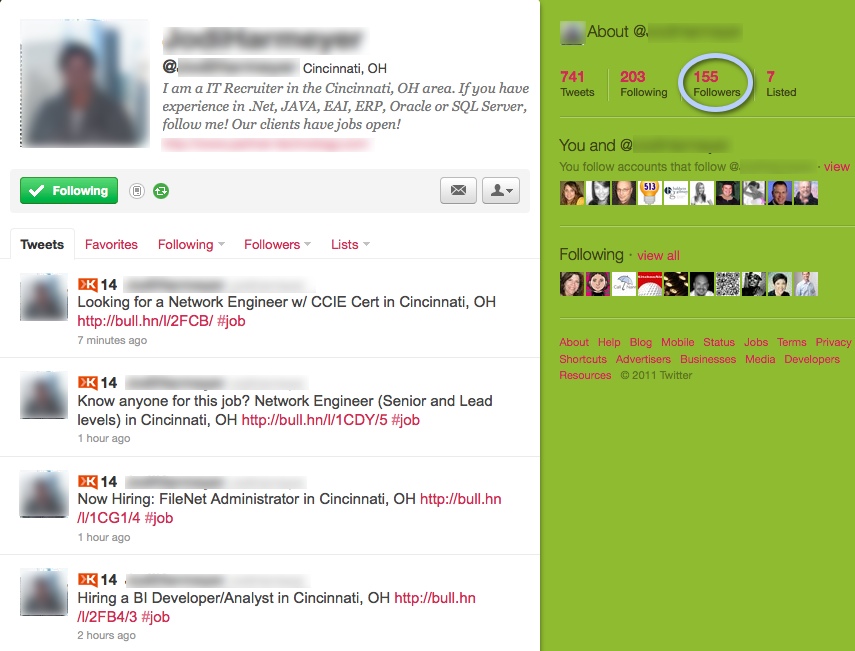
1. Posting only job links

The best way to find the least value from Twitter as a Recruiter is to post only links to the jobs that you’re recruiting for. Why? Because just as no one would want to spend time talking with a Recruiter at a networking event who only spouted job links, they also don’t want to “talk” to them on Twitter.

Twitter is about engaging in conversation and adding value. Recruiters who only post job links typically have very few Followers and the visibility for all of those links they’re sharing is practically nil. These Recruiters are often the first to say “Twitter doesn’t work for recruiting”. At least not the way they’re doing it.

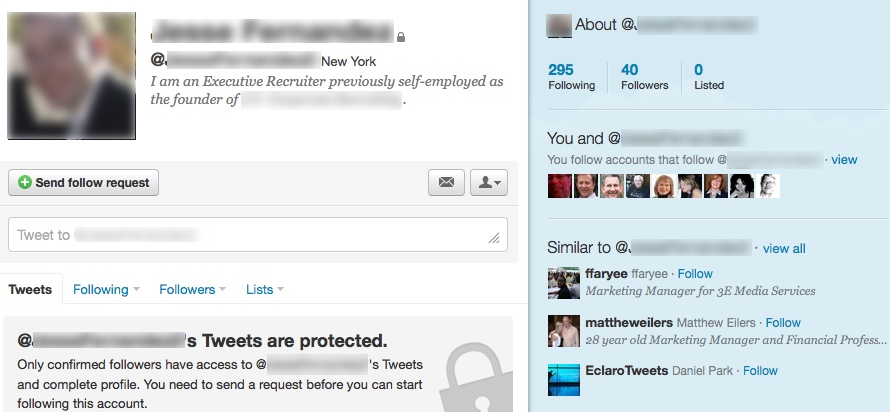
2. Protecting Tweets

Nothing says “I’m looking to build some mutually beneficial business relationships” like not trusting others with the information you share. Twitter is designed to be most effective when you’re able to access and participate in the larger conversation. Personally, I don’t follow accounts with protected tweets and they typically have very few Followers. Why? Because they’re doin’ it wrong.

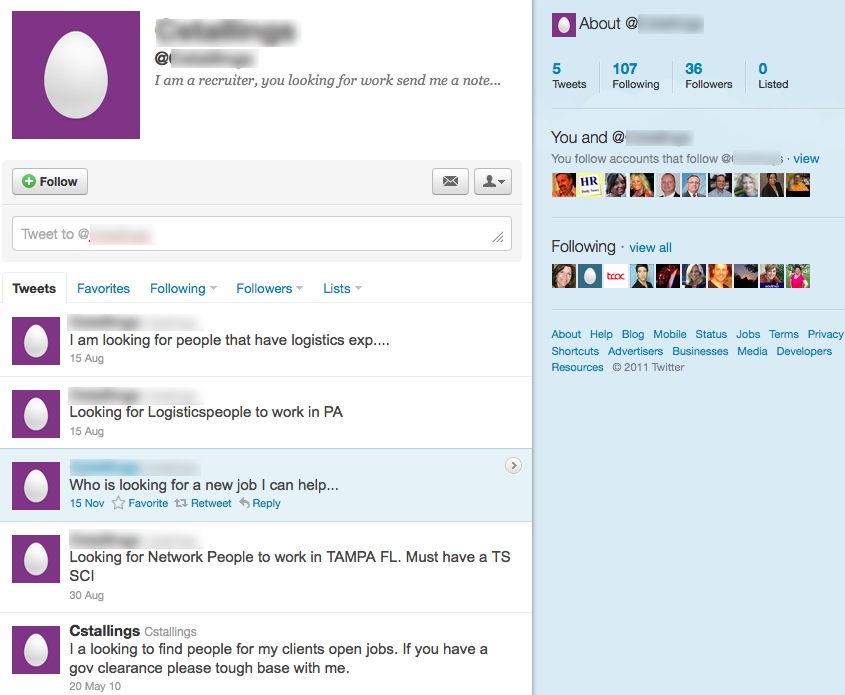
3. Incomplete Bio/No Profile Photo/No Website Link

Want people to follow you on Twitter? Give them a reason to do so. You’ve got 160 characters to build interest, include keywords and share a bit about yourself. People make Follow decisions quickly on Twitter. If you’re not interesting or inviting, they’ll likely not connect. And for gosh sakes, give them a way to find out more about you/your company with a link to your careers page, company website or at least your LinkedIn profile. The Recruiter below is asking job seekers to get in touch with him, but provides no way to do so. My guess is – they’re not.

4. Engaging and Interacting Primarily With Other Recruiters

Many Recruiters who’ve given Twitter a shot and feel it’s not worth it may have joined and connected only with a few friends (other Recruiters) – and never really sought out or developed a following among people in the industries or professions in which they recruit. While Twitter can be helpful for finding other Recruiters for split opportunities (3rd party Recruiters), you won’t be able to find fish unless you fish where the fish are.

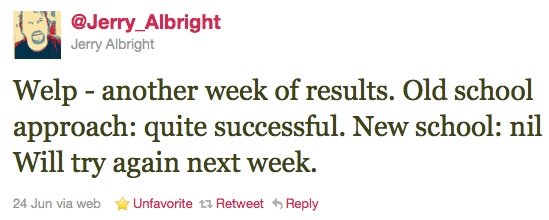
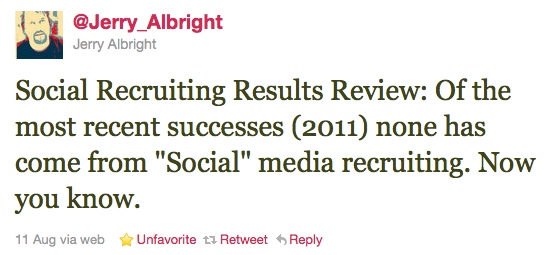
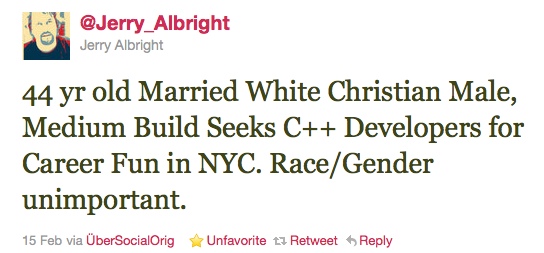
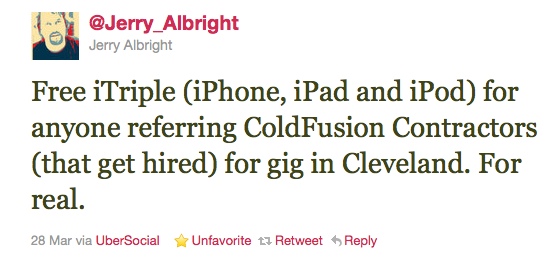
For example, take my favorite “anti-social” Recruiter – Jerry Albright. Jerry has long been a super successful Recruiter, but he regularly touts the lack of benefits he sees from Twitter.

Take a look at Jerry’s Twitter timeline, and most of his interactions are with other Recruiters and industry associates. However, many of the IT and Engineering types he recruits for are definitely on Twitter. In my opinion, the only thing standing between a Recruiter like Jerry and Twitter success is building a larger following and engaging more within the IT and Engineering communities. Jerry is funny, informative and shares legitimate job openings. It’s likely he could snag one of those illusive “passive candidates” for one of his openings who aren’t even looking, but follow him because of his humor and wit.

5. NOT Talking About What You Had For Lunch

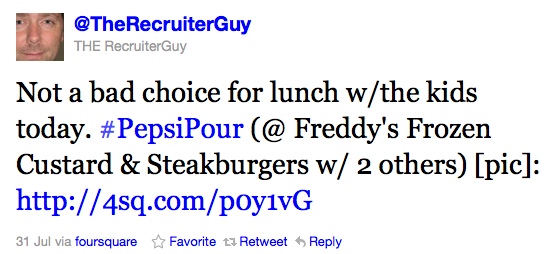
I recently attended a Recruiting Conference where the VP of Talent Acquisition at a local Fortune 200 company mentioned that his company was not using Twitter as a part of their recruiting strategy because “we don’t want our recruiters tweeting about what they had for lunch”. While I would certainly agree that Recruiters (and other employees) need training and guidance on how to best represent themselves and their companies on Twitter, I think this VP has missed the point of Twitter. Being a “whole person” on Twitter and sharing hobbies, interests, photos and tidbits from daily life makes for a more interesting person to follow and can position a Recruiter to share job openings and company information with a broader community of Followers.

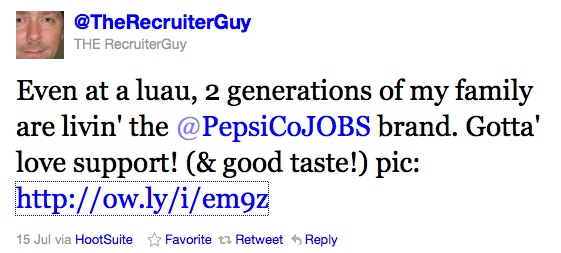
For example, Chris Hoyt – Talent Engagement & Marketing Leader at PepsiCo. – classifies himself as a “life streamer” and has built quite a following by sharing interesting and funny tweets from his work, family and personal life along with regular mentions of the brands that he works with and the jobs his team is recruiting for.

In summary, to make this “Using Twitter For Recruiting” thing work, DO the following:

  1. Engage and add value with your tweets.
  2. Take advantage of the ability to build your network – by allowing people to connect with and follow you.
  3. Provide good information in your Bio to encourage Followers and include an appropriate link to learn more about you/your company.
  4. Follow and engage with people in the professions and industries that you recruit for – in addition to friends and professional peers.
  5. Be yourself. People want to follow real people – not auto-tweeters or corporate robots.

*

What do you see Recruiters doing wrong on Twitter – or what are some best practices you can share for recruiting success? Comments are appreciated!

Categories: Blog, Recruiting, Twitter
Posted on August 17, 2011

  • « Previous Page
  • 1
  • …
  • 28
  • 29
  • 30
  • 31
  • 32
  • …
  • 48
  • Next Page »

Recent Posts

  • Why HR Should Be the Chief Disruption Officer in Every Organization
  • Mastering the Art of Virtual Networking: 5 Steps to Build Powerful Connections Online
  • Networking for Introverts: Practical Strategies for Building Meaningful Connections with Greg Roche
  • Leading with Vulnerability: The Key to Future-Ready Leadership with Jacob Morgan
  • Future Fluidity and the Evolving Role of Leadership in the Age of Disruption With Dr. Tanvi Gautam

Categories

Archives

Need A Speaker?

I've delivered keynotes and led workshops at over 350 conferences and corporate events.

If you want to check my availability for your event, or if you have questions, click below.

Start the Conversation »

Recent Blog Posts

  • Why HR Should Be the Chief Disruption Officer in Every Organization
  • Mastering the Art of Virtual Networking: 5 Steps to Build Powerful Connections Online
  • Networking for Introverts: Practical Strategies for Building Meaningful Connections with Greg Roche
  • Leading with Vulnerability: The Key to Future-Ready Leadership with Jacob Morgan
  • Future Fluidity and the Evolving Role of Leadership in the Age of Disruption With Dr. Tanvi Gautam

Connect on Social

  • Facebook
  • Instagram
  • LinkedIn
  • Twitter
  • Vimeo

Copyright © 2026 · Jennifer McClure · Privacy Policy

Copyright © 2026 · McClure Pro on Genesis Framework · WordPress · Log in