Jennifer McClure`

Equipping people leaders to navigate change — and design the future — with boldness and purpose.

  • About
  • Speaking
  • Schedule
  • Blog
  • Impact Makers Podcast
  • Contact

Written by Jennifer McClure

5 Things New Leaders Should Do to Set Themselves Up for Success

Congratulations! You’ve just been promoted or selected for a new leadership role, and you’re ready to embark upon the next phase in your career as a new manager of a team.

How can you set yourself up for success as a new leader?

Start by setting the following goals that focus on your team, your career, and your continued personal development:

1. Prioritize time on your calendar to meet your new team.

Within your first few days as a new leader, schedule a meeting with each of your new team members to get to know them — and to listen. Ask about their hobbies, their career goals, what they like or don’t like about their job, and if they have any ideas about what could be improved.

It’ll be easy to get lost in your new responsibilities and the plans for achieving your own goals, but never forget that it will take a team to help you get there.

Your team will be more engaged and committed to your success and overall company performance if you earn their trust and confidence, show a genuine interest in their wellbeing, and help them to connect their job to organizational goals.

2. Schedule 3 – 4 networking calls or meetings each month.

As a new leader, you’ll benefit from building relationships outside of your company through professional associations, alumni groups, and online social networks. Building a strong network is one of the most effective ways to grow your career, and these connections can provide you with a variety of perspectives throughout your career.

It’s important to be intentional about networking and connecting, and you should consider it an ongoing career development activity. Don’t wait until you’re in a time of need (such as beginning a job search) to get started, and make sure you prioritize your networking meetings by scheduling — and protecting — networking time on your calendar.

3. Choose your mentors and create a formal process for each relationship.

Billionaire business leaders Richard Branson and Oprah Winfrey, as well as former PepsiCo Chairman & CEO Indra Nooyi have all benefitted from the wise advice and counsel of mentors throughout their careers, and so can you.

The right mentor can help you navigate tricky career decisions and connect you with people in their network who can open doors or create opportunities.

When choosing a mentor, seek out individuals who will be supportive but also frank with their advice and counsel. The best mentors are able to listen, serve as a sounding board, and share their perspective and experiences to position you for success.

Once your mentor has agreed to help you, be intentional about your relationship. Establish how often you’d like to connect in-person or on the phone, what your goals are for the process, and anything that you may be able to provide your mentor in return.

Keep in mind that your experiences and insights are valuable as well, and mentoring relationships should be mutually beneficial.

4. Read two to four books each month.

As you step into your new responsibilities, you’ll want to quickly get up to speed on everything you need to know about your company and your role, which will involve plenty of reading and studying. But to keep your thinking fresh and your mind creativity engaged, it’s important to not fall into the trap of turning off outside influences.

Daily reading can challenge your thinking and open your mind to possibilities, and it’s also been documented as a key success habit by author Tom Corley. For five years, Corley studied the daily habits of both extremely successful people and those living in poverty. The results were documented in his best-selling book Rich Habits – The Daily Success Habits of Wealthy Individuals and revealed that 88% of self-made millionaires in the study spent at least 30 minutes each day reading to learn.

It doesn’t matter where you’re getting the information—it could be Facebook or Twitter. The important thing is that you’re educating yourself.

~ Tom Corley

The habit of reading every day actually grows your brain and increases cognitive abilities. In other words, it makes you smarter 💡, while also developing your leadership qualities.

5. Take 10 minutes each morning to journal about the previous day.

Starting each day with a few moments of self-reflection is a great way to mentally prepare for a positive and productive start to your day by clearing out mental cobwebs, refocusing on what matters and intentionally setting yourself up for success. Daily writing can provide a cathartic release valve for the stresses of your daily life, and it can also be a powerful tool to assist you in evaluating your current circumstances, as well as your future goals and dreams.

In the book, The Progress Principle: Using Small Wins to Ignite Joy, Engagement, and Creativity at Work by Teresa Amabile and Steven Kramer, the authors assert that keeping a daily journal of work activities is one of the best strategies for learning about yourself and improving your professional performance over time.

A daily journal can also serve as a reference when the time comes to present your accomplishments (such as pitching yourself for a promotion), and it can also be helpful to look back to identify trends and personal growth, and to reflect on what you’ve learned along the way.

—

Based upon my experience coaching and working with high-performing leaders for the past 30 years, I can assure you that setting and implementing these five goals will not only be helpful to you in getting off to a great start as a new leader, but they’ll also benefit you throughout your entire career.


As a keynote speaker and leadership coach, Jennifer McClure helps leaders to embrace the future of work, and to develop the skills necessary to lead their organizations and the people on their teams to take bold actions that positively impact business results.

Want more leadership and future of work insights from me?

SUBSCRIBE to get my weekly Impact Makers newsletter delivered to your inbox!

Categories: Blog, Leadership
Posted on September 5, 2023

Written by Jennifer McClure

Simplify Creative Problem-Solving and Innovation Using Light Bulb Thinking™ With Innovation Coach Ellia Harris

Discover the power of creative problem-solving!

On episode 90 of the Impact Makers podcast, I’m chatting with Innovation Coach Ellia Harris – an expert in creative problem-solving and creating cultures of innovation. Ellia works with managers, business owners, and their teams to get them out of habitual thinking, so they can find creative solutions that they couldn’t see before.

The creator of Light Bulb Thinking™, Ellia has over a decade of experience as an organizational trainer and coach, and her own experience as a manager seeking a creative approach to leadership led to her expertise in using creative thinking as the fastest route to becoming an effective leader of a high-performing team – which, in a time when we all need to be at the top of our game, is more crucial than ever.

I think you’ll enjoy my conversation with Ellia, because she reminds us that everyone has the capacity for creative thinking and creative problem solving — and thinking differently about some of the challenges that you’re facing may be the best way to identify the solution that you need to move forward.

Topics Discussed In Today’s Episode:

  • What is creative problem-solving?
  • Ellia’s Light Bulb Thinking™ framework for creative problem solving: planning, ideating, choosing, and then implementing or innovating.
  • The four categories of creative thinking tools for when you’re ideating: Re-expression, Revolution, Random Links, and Related Words.
  • Why many of us struggle with being creative, and how we can overcome how our brains are naturally designed to work.
  • How AI tools like ChatGPT and Bard can be used to fuel creativity — and how they should not be used.
  • Ellia’s passion for helping young people to develop leadership and creative problem-solving skills.

LISTEN TO IMPACT MAKERS PODCAST – EPISODE 90

Listen on Apple podcasts, Google podcasts or Spotify

People & Resources Mentioned In This episode:

Ellia Harris – LinkedIn

Contact Ellia – Hello@ThePotentialCenter.com

The Potential Center – Website, Facebook, YouTube

Light Bulb Moments™ online course

Book: Winner’s Mindset: Peak Performance Strategies for Success (contributor)

Impact Makers podcast episode 067: How to Make Work Suck Less By Making It Fun with Jeff Harry

Impact Makers podcast episode 084: Poetry, Hip Hop, and HR: Creativity and Leading in the Future of Work With Arend Boersema

Categories: Blog, Podcast
Posted on September 5, 2023

Written by Jennifer McClure

You Don’t Have to Be Perfect to Lead With Impact: 5 Ways to Make a Difference

When you think about people who have changed the world in positive and meaningful ways, who comes to mind?

Maybe you think of people like Martin Luther King Jr., who dedicated his life to the nonviolent struggle for civil rights in the United States, or Steve Jobs who brought products into play that transformed our lives and redefined entire industries, or Mother Theresa, whose higher purpose was to care for the poor, the sick, and the disadvantaged around the world.

It makes sense that these individuals are thought of as world-changers. They’ve invented products, or started movements that have had a lasting impact on us all.

Now, I want you to think about who has changed YOUR world.

On your list, you might include a parent, a religious leader, a boss, or even a teacher. These types of people hold places in our lives that position them for great opportunities to influence.

But what about you?

Would anyone name you as someone who has influenced his or her life?

If not, why not?

5 Reasons You May Think You Can’t Change the World

1. I’ve got nothing to offer.

If you’re a human, the truth is that there are many good things – and maybe a few not so good things – that make up who you are.

So, even without much effort, you’ve got something – and you can use your life experiences to help someone else.

2. I’m really not that interesting.

The good news is that influencing others is not about you. It’s about them.

You influence others by focusing on their story – not yours.

3. I’m not super successful.

Your level of success in being of value to others has less to do with your own accomplishments, than your ability to listen.

Many people are seeking mentors who they can simply talk to, who will listen, and then share their perspective.

4. I’ve got some skeletons in my closet.

We all do. Failure makes us human.

It also means that there’s someone out there who can relate to – and learn from your failures.

(So can you.)

5. Nobody has ever asked me to be a mentor or influencer in their life.

Then your first opportunity is waiting for you!

Don’t wait for someone to ask you to speak into his or her life. Most likely, the people who have influenced you the most weren’t invited to do so.

So how CAN you change the world?

One person at a time.

You don’t have to invent something with lasting impact or create a movement to change the world.

There is somebody in your life that needs your influence.

There is somebody in your life that is ready to benefit from your knowledge, skills and expertise.

As Steve Jobs once said:

“…the ones who are crazy enough to think that they can change the world, are the ones who do.”

I believe that you can change the world.

Just do it.

You CAN Change The World – a DisruptHR Talk by Jennifer McClure – CEO of Unbridled Talent LLC & Chief Excitement Officer of DisruptHR LLC

___________________________

As a keynote speaker and leadership coach, Jennifer McClure helps leaders to embrace the future of work, and to develop the skills necessary to lead their organizations and the people on their teams to take bold actions that positively impact business results.

Want more leadership and future of work insights from me?

SUBSCRIBE to get my weekly Impact Makers newsletter delivered to your inbox!

Categories: Blog, Leadership
Posted on August 29, 2023

Written by Jennifer McClure

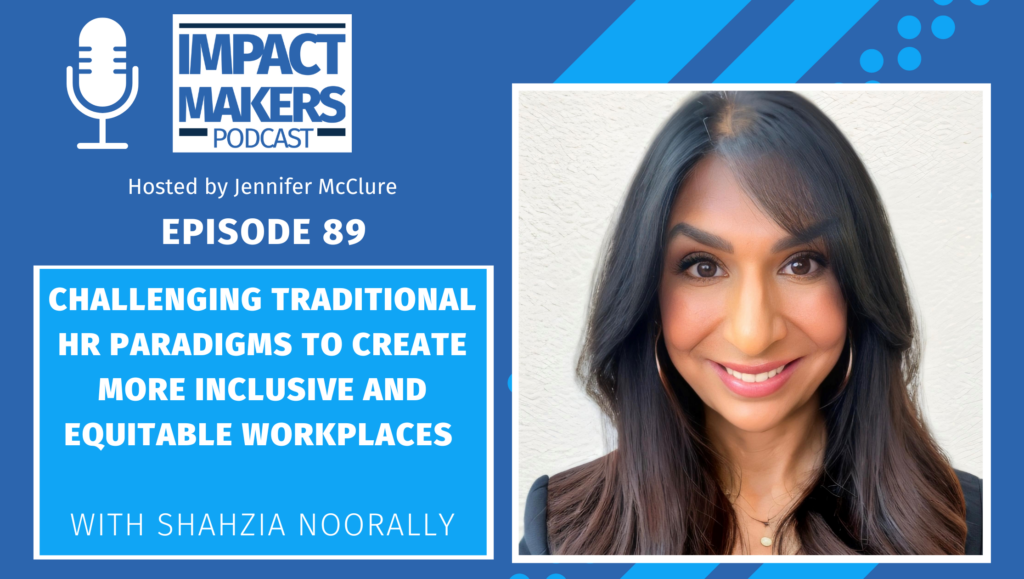
Challenging Traditional HR Paradigms to Create More Inclusive and Equitable Workplaces With Shahzia Noorally

On episode 89 of the Impact Makers podcast, I chat with Shahzia Noorally, a Diversity, Equity & Inclusion practitioner, Speaker, and podcast host.

With her dynamic voice, Shahzia is changing the narrative around workplace authority and equity. In our enlightening conversation, she shares her inspiring journey from a place of isolation in her first leadership role, to becoming a passionate advocate for equity within the utilities industry and beyond. Her unique insights are shaped by her experiences as a woman of color, a child of immigrants, and an HR practitioner.

Our conversation takes us through the challenges and biases that persist in traditional leadership and mentorship models, and we also explore the concept of sponsorship, which can create a space for authentic expression, amplifying not just talent but also the voices that often go unheard.

I first met Shahzia when we were both speaking at a DisruptHR Calgary event back in 2019 and have been following her and her work since that time. I find her to be insightful and purposeful, and I really appreciate how she approaches equitable work and workplaces through a lens of possibilities rather than challenges, and a purpose that is rooted in influencing a more just-world.

Outside of her work, Shahzia hosts The Equity Gap podcast, and she leans into community, anchoring her energy towards amplifying Black, Indigenous and women of color to show up in the world, and take up all the space that they desire and deserve.

I think you’ll enjoy learning from Shahzia in our conversation, and I encourage you to share this podcast with others in your network who may benefit from rethinking some of our traditional approaches to Diversity, Equity, and Inclusion in the workplace.

Topics Discussed In Today’s Episode:

  • The challenges of relying solely on the concept of “diversity of thought” and why demographic representation is vital.
  • Why current leadership models need rethinking to encourage individual authenticity instead of molding individuals to fit pre-existing molds.
  • How sponsorship stands apart from traditional mentorship and can be more helpful in addressing systemic barriers faced especially by BIPOC.
  • Why modern workplaces must adapt to become inclusive, ensuring everyone has equal access to influence, and challenging traditional white male-centric leadership models.
  • The broader implications related to equity that extend well beyond equal pay.
  • The importance of optimism in addressing diversity and inclusion challenges with an open mind and proactive attitude.
  • Why a paradigm shift from a one-size-fits-all approach in HR practices to one that centers the experiences of the most marginalized employees is necessary, and how that can lead to broader benefits for all.

LISTEN TO IMPACT MAKERS PODCAST – EPISODE 89

Listen on Apple podcasts, Google podcasts or Spotify

People & Resources Mentioned In This episode:

Shahzia Noorally – LinkedIn, Website, Instagram

The Equity Gap podcast – On Apple Podcasts, LinkedIn, Instagram

HR, We Have A Problem | Susy Ko & Shahzia Noorally | DisruptHR Talks

Do You Know the Reference Man? | Shahzia Noorally | DisruptHR Talks

Rethinking podcast with Adam Grant: Finding–and becoming–great mentors and sponsors with Carla Harris

The Equity Gap podcast: From saviorism to solidarity in the workplace – a conversation with Dr. Golnaz Golnaraghi – Changemaker, Speaker, Author & Founder of Accelerate her Future

Accelerate Her Future

Categories: Blog, Diversity Equity and Inclusion, Podcast
Posted on August 29, 2023

Written by Jennifer McClure

How to Deliver a Killer Presentation: Avoid These 5 Common Mistakes

I make my living as a professional communicator, which means I have the honor of speaking to audiences at conferences, association meetings, and corporate events all over the world.

One of the benefits that I truly enjoy when speaking at events is attending other keynotes, breakout sessions, or workshops whenever possible. I’m always interested in learning, and I also want to watch great speakers in action, so I can continue to grow and improve my speaking skills as well.

At a recent conference, I chose to attend a breakout session led by a speaker with an impressive title. His bio listed many professional accomplishments and years of experience in a topic that I was very interested in learning more about. Even though his session was scheduled a few hours before my closing keynote, I made a point to get to the convention center early in order to take advantage of the opportunity to learn from him.

Unfortunately, very quickly into the 75-minute session, it became clear that learning was going to be a challenge. Even though his professional experience and accomplishments related to the subject were impressive, the speaker conveyed zero excitement or passion for the findings of the case studies and research that he shared, and he didn’t seem to care at all about connecting with the audience.

Pretty soon, in an effort to salvage my time investment, my note taking shifted towards capturing quotes and actions from the speaker that affected my ability to learn from him.

10 Audience Engagement Killers

  1. “I’m not going to bore you with that…”
  2. “We don’t have time to talk about that today…”
  3. “What time is it?”
  4. “Here’s a picture of an article I wrote in 2008…”
  5. “I’m not going to go through each one of these…”
  6. “How much time do I have left?”
  7. “There are a variety of reasons for this, we just don’t have time to talk about them here…”
  8. “I’m not going to go into this, it’s too involved for this gig…”
  9. “Am I still okay on time?”
  10. “This slide shows a whole bunch of reports which focus on financial metrics. Blah, blah, blah, blah…”

The 10 statements above were exact quotes from the speaker during this session – even number ten.

Unfortunately, I left the session frustrated, because myself – and about 150 others – had wasted 75 minutes of our time. We had met the speaker’s expectations of not being able to understand or take action on the information presented, but he did not meet my expectations as an audience member – which is for the speaker to provide value.

I can guarantee you that no meeting planner plans for their audience to leave a session having learned nothing new or at least challenged to try something new – and no speaker should either.

As someone who has been speaking on stages for over 15 years, I know that speaking in front of any size of audience can be tough on the ego. Even when I feel that I’ve knocked it out of the park, there is always someone in the audience who didn’t connect with my material, or who didn’t care for my delivery.

But I also know that I can increase the odds that my message will connect with the majority of audience members if I can answer the following question:

“What do I want the audience to DO with this information following my presentation?”

Once I have the answer to that question, I then need to care enough to use the time that I’ve been given to help the audience to understand why and how it’s possible for them to do just that.

Successful speakers care about the audience and their learning experience.

If you’ve been selected or appointed to speak in front of an audience – you’ve been given the valuable gift of people’s time. Whether it’s a keynote in front of thousands, a DisruptHR Talk, or a presentation to your team in a conference room, you can show your audience respect and appreciation by never making the following mistakes as a speaker:

5 Mistakes Successful Speakers Never Make

1. Never show, mention, or refer to something the audience cannot see clearly on the screen.

Examples: “I know this is an eye chart, but…” or “You can’t see this, but let me tell you what it says…”

2. Never show a statistic, reference a study, or display a quote without also sharing the source.

Who said this? When was it? How can I follow up to learn more? <- What your audience is thinking.

3. Never include stats, studies, or reference material on a slide that is more than 2 years old.

If your idea or premise is based upon 10-year-old research, find (or create) new research to support it.

4. Never refer to your own presentation materials, content or speaking style as boring.

Don’t plant seeds that you don’t want to grow. If the audience wasn’t already thinking that – they surely are now.

5. Never ask how much time is left for your presentation.

Asking the audience about time remaining shows a lack of preparation – and implies that you plan to fill the allotted time – no matter what. Bring a clock, use a time app on your phone, or have a friend hold up a sign to keep track of time – but never ask the audience to do it for you!

Any presentation that you create and deliver should be with the goal of educating, informing, encouraging and inspiring your audience. They’ll love you for it – and maybe they’ll even say something nice about it afterwards!


Do you want to build your personal brand and share your expertise as a speaker?

Download my free guide today: 10 Tips to Build Your Brand and Land Gigs as a Speaker – to discover how!

The guide includes links and examples of how successful speakers are marketing themselves using online and offline tactics and strategies.

Categories: Blog, Effective Communication, Speaking
Posted on August 22, 2023

  • « Previous Page
  • 1
  • 2
  • 3
  • 4
  • 5
  • 6
  • …
  • 57
  • Next Page »

Recent Posts

  • Why HR Should Be the Chief Disruption Officer in Every Organization
  • Mastering the Art of Virtual Networking: 5 Steps to Build Powerful Connections Online
  • Networking for Introverts: Practical Strategies for Building Meaningful Connections with Greg Roche
  • Leading with Vulnerability: The Key to Future-Ready Leadership with Jacob Morgan
  • Future Fluidity and the Evolving Role of Leadership in the Age of Disruption With Dr. Tanvi Gautam

Categories

Archives

Need A Speaker?

I've delivered keynotes and led workshops at over 350 conferences and corporate events.

If you want to check my availability for your event, or if you have questions, click below.

Start the Conversation »

Recent Blog Posts

  • Why HR Should Be the Chief Disruption Officer in Every Organization
  • Mastering the Art of Virtual Networking: 5 Steps to Build Powerful Connections Online
  • Networking for Introverts: Practical Strategies for Building Meaningful Connections with Greg Roche
  • Leading with Vulnerability: The Key to Future-Ready Leadership with Jacob Morgan
  • Future Fluidity and the Evolving Role of Leadership in the Age of Disruption With Dr. Tanvi Gautam

Connect on Social

  • Facebook
  • Instagram
  • LinkedIn
  • Twitter
  • Vimeo

Copyright © 2026 · Jennifer McClure · Privacy Policy

Copyright © 2026 · McClure Pro on Genesis Framework · WordPress · Log in