Jennifer McClure`

Equipping people leaders to navigate change — and design the future — with boldness and purpose.

  • About
  • Speaking
  • Schedule
  • Blog
  • Impact Makers Podcast
  • Contact

Written by Jennifer McClure

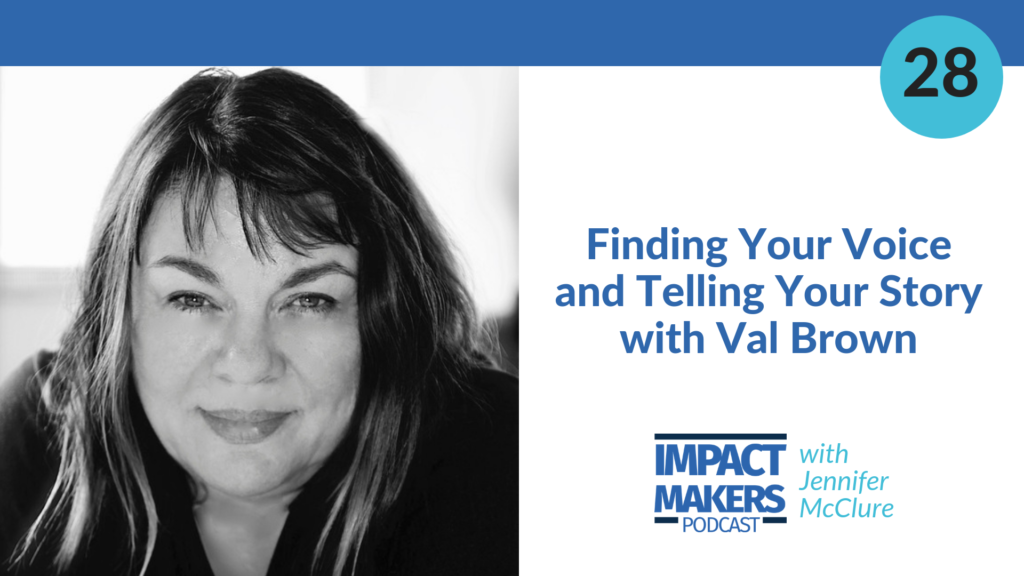
Finding Your Voice and Telling Your Story with Val Brown

Whether you’re thrilled or terrified to talk about your story, it’s important to remember that everyone has something unique to share with the world – one that’s meaningful and inspiring. But how do you tell your story without compromising your authenticity? Today’s guest is Jennifer’s good friend and host of Camera Ready, Val Brown. Their conversation unravels the effect our voice and story play in business and the people around us, and why it takes more than talking in front of a camera to get your story across.

  • Val Brown is an Emmy Award winner and the founder of Visual Bridge Communication. VBC helps leaders and businesses tell their stories and become more fluid in front of the camera. Val’s passion and excellence in journalism and communication has led her to an award-winning career.
  • What are some expert tips when it comes to being an effective host/communicator? Read and practice your material. Take care of your voice: drink water and get enough sleep. Own your voice and don’t forget to breathe. Val explains that our voice is like a muscle, and warming up is vital for delivering a successful presentation. Just as athletes don’t skip their warm-up routines for a big event, we shouldn’t either.
  • After shifting from corporate to the public sector, Val saw the power of articulate messaging. How changing the organizational language changes people’s quality of life. She learned that by changing the language, they changed the conversation. And by changing the conversation, they changed the company culture.
  • She eventually joined a consulting group, which later inspired her to start her own business. Val saw the huge training demand that leaders and entrepreneurs had in the communications sector. She found great delight in helping people gain skills and move past their limiting beliefs – this was obviously her calling.

Val shares her best practice broken down to 3Ps: Purpose, Plan, and Presence. (Get the Camera Ready Guide!)

  • Understand your purpose. What is this video for? What do you want it to do for you? Why did you invest time and effort into creating this?
  • Create a plan to support your purpose. The plan involves laying out your message, how and where you’re going to deliver your message. Your plan must fit your purpose.
  • Align your mind, heart, and gut to establish your presence. People know when we’re not being authentic. By aligning the mind, heart, and gut, we come across as genuine – people are more receptive to messages that come from an honest source. Our audience needs to feel our enthusiasm when we share our message. Before we can get them to believe our story, we have to believe in it first.
  • What are some of the foundations when it comes to speaking in front of the camera? Because people are on this journey at different levels, part of Val’s process is to meet them where they are. They work through the client’s self-limiting beliefs first. Once they know that they can do it, they become more comfortable with the idea of being in front of the camera. After they’ve established their confidence in telling their story, then they move on to polishing techniques and existing skills.
  • “Audio without video is radio.” – Val Brown, Jennifer and Val talk about other investments and guidelines to consider when doing video such as lighting, wardrobe, makeup, and audio quality, and how it affects audience engagement.

As with anything in business, it all must serve a purpose – your story is no different. Tell your story, but do so with the genuine intent to connect with your audience all while staying true to your brand’s core values. Your story tells more about you and your brand than you think, so make it work for you. Remember: Purpose, Plan, and Presence – and match it with other presentation guidelines like colors, lighting, and audio quality.

Want a little help creating your personal brand?

Jennifer has a free resource for you. The Personal Brand Workbook will help you figure out what your personal brand is today and what you want to be known for in the future, as well as how you want to impact the world. Download it today!

Val Brown

Free Download: Camera Ready Guide
Visual Bridge Communication

Camera Ready with Val Brown – iTunes

LinkedIn

Facebook

Twitter

Categories: Blog
Posted on September 27, 2018

Written by Jennifer McClure

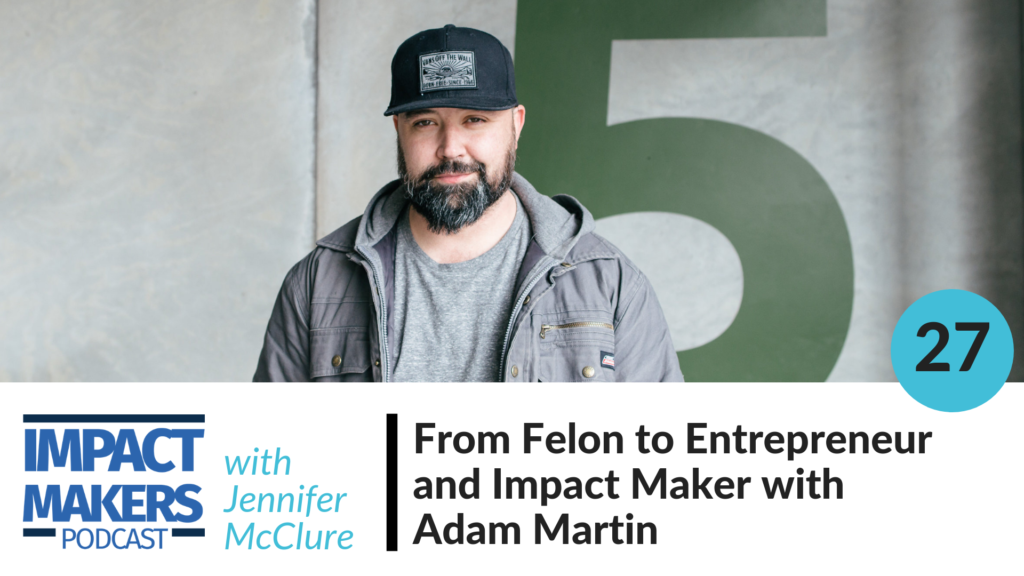
From Felon to Entrepreneur and Impact Maker with Adam Martin

What if we were all given an unlimited amount of grace despite our shortcomings? Adam Martin is the Founder of F5 Project, an organization that provides job and housing opportunities to felons leaving the prison system so they can have a sense of purpose and the confidence to re-enter their communities. Today, Jennifer and Adam dive deep into how the social stigma that surrounds felons effects their successful reentry into society and how we can do better in providing equal job opportunities to this untapped yet promising workforce.

  • Adam Martin is dedicated to helping others overcome the things he has in his life: alcoholism, drug abuse, and a criminal background that includes 5 felonies. His work on the F5 Project has been a game-changer for many lives.
  • Most felons are left with jobs that barely get their bills paid. They are given lower wages, higher expectations, and not enough room to succeed. With social stigmas holding back several socio-demographics, especially the vulnerable ones, Adam has one question: “What if we weren’t so quick to judge and brand people as unworthy?”
  • If you want a story about reform, then Adam has one for us. After leaving the prison system, he had worked at a car wash, served and waited tables at restaurants – jobs that weren’t enough to support his family. Despite the setbacks, he knew that wasn’t what he wanted to do the rest of his life. Instead, he was going to find purpose and end the paycheck-to-paycheck cycle.
  • He eventually got a job at an information technology company as an outside sales representative. They hired Adam even after knowing about his past, but he didn’t have the same advantages as the other employees. He didn’t have a license, he didn’t have a car – the things that would enable him to do his job efficiently. But that didn’t stop him from bringing in the sales needed to get him noticed by the higher-ups. He took the bus, he rode his bike, and he did everything he could to earn his keep. His dedication paid off. By his first year, he had made the company a million in revenue – an astonishing feat, even for non-felons.
  • This brings us to how social stigma against felons hurt their opportunity for reform and successful reentry into society. Hiring people always comes with risks, but people aren’t just data. They are not just their standardized test results and their previous life choices. These individuals have hopes and dreams too.
  • Most of the time, it’s because we’ve marked them as failures that they have ended up identifying themselves as such – this is not okay. Adam isn’t trying to get every felon hired, but he does want to advocate for those who are actually a good fit for businesses.
  • Bad things can happen to anyone and that can push people into making hasty decisions, but that shouldn’t dictate that person’s opportunity to live a decent and fulfilling life. Nobody is perfect, and people should be allowed to grow and change for the better.
  • Jennifer probes into how employers can overcome their fear of hiring felons, so Adam shares the 2 things he looks for in a potential hire: First, he wants complete transparency from the applicant and to know what their crime was, and second, what the applicant is doing every day to ensure that they don’t go back to prison and how they give back to the community. A shift in perspective is all it takes to make the workplace a better place.

Want a little help creating your personal brand?

Jennifer has a free resource for you. The Personal Brand Workbook will help you figure out what your personal brand is today and what you want to be known for in the future, as well as how you want to impact the world. Download it today!

Where to find Adam:

Adam Martin LinkedIn

Adam Martin Twitter

Adam Martin F5 Website

F5 Project Facebook

Adam Martin – Founder of F5 Project I Keynote Speaker I United Way 2016

A Fine Line Between Felon and Entrepreneur | Adam Martin | TEDxNDSU

Awesome F*$#ing Story – F5 Project

Other resources:

Rich Roll Podcast – John McAvoy

Hiring People With Backgrounds: Looking Past The Data To The Person | Adam Martin | DisruptHR Talks

DisruptHR

We Are All Criminals by Emily Baxter

Some of the links in the post above are “affiliate links.” This means if you click on the link and purchase the item, I will receive an affiliate commission. Regardless, I only recommend products or services I use personally and believe will add value to my readers. I am disclosing this in accordance with the Federal Trade Commission’s 16 CFR, Part 255: “Guides Concerning the Use of Endorsements and Testimonials in Advertising.”

Categories: Podcast
Posted on September 6, 2018

Written by Jennifer McClure

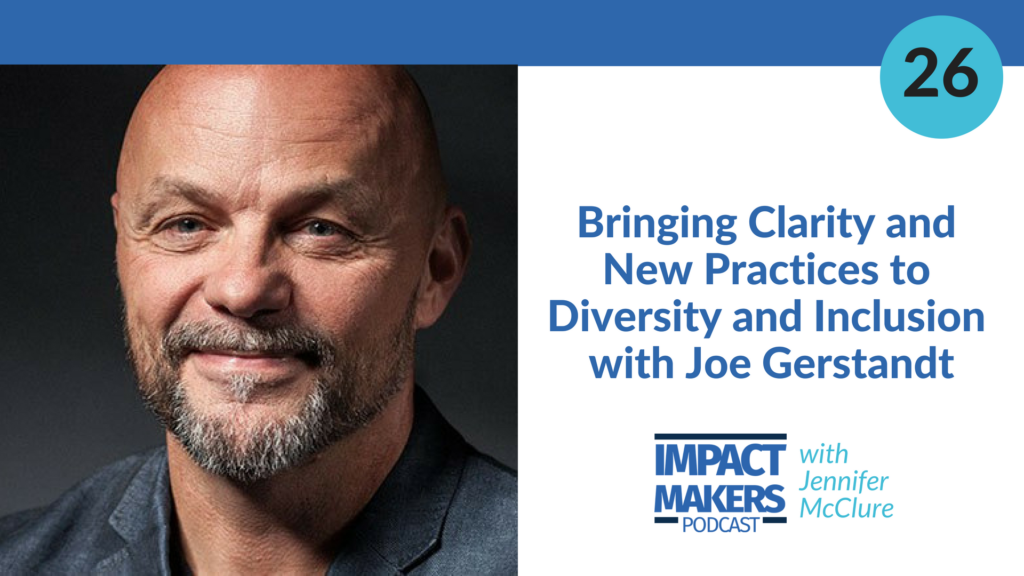
Bringing Clarity and New Practices to Diversity and Inclusion with Joe Gerstandt

Joe Gerstandt isn’t just a straight white dad with tons of tattoos. He’s also an expert on diversity and inclusion who has trained leaders at Fortune 500 companies, non-profits, the government, and more. He also speaks on how each of us can become conscious champions for diversity and inclusion in our work and in our lives. Jennifer and Joe talk about his journey from small-town America to where he is today, and what he teaches that changes so many people.
  • Joe grew up on a farm in a small town in a class of 26 kids. From there he went into the Marine Corps for four years, a transformational experience in terms of diversity. Then Joe went from sales to working in a non-profit, and finally into corporate life before becoming the thought leader he is today. But when Joe talks about how he got from there to here, his guiding principle was that he was a person who made mistakes and LEARNED from them. As a young adult, Joe didn’t believe things like racism, sexism, and other forms of discrimination really existed. Joe shares how those feelings changed radically over his professional career.
  • One of the things that ‘lit him on fire’ in the Marine Corps was, despite the terrible pay and living conditions, Joe believed in what he was doing. He had strong leadership and a chance to advance through meritocracy. Why does this matter? Because Joe believes in bringing the same passion to get people to rally around becoming champions for diversity and inclusion. He explains the lessons he learned in the Marines and how he’s applied them to his current endeavors.
  • After he worked in a sales job – a very dark time in his life – Joe became part of a non-profit for AIDS. He had long since left his homophobic beliefs behind, but he didn’t leave behind the need for purpose like he felt in the military. Joe shares the shocking revelations he had while working for the non-profit that reshaped the way he looked at the world and his place in it.
  • The next stop in Joe’s journey landed him as the Diversity Director at a healthcare facility, where he built the diversity program from the ground up. Neither the company nor Joe had a clear idea of what he should be doing, and Joe reveals the worst thing the company did when it came to its attitude about diversity and inclusion: they considered themselves ‘good people.’
  • After that last work experience, Joe finally found his purpose, and he decided to work for himself. But the way it happened wasn’t what he expected, nor did he expect to be as such peace about it. Joe had some rough times as he stepped out as a speaker and consultant, and he shares one of the most pivotal moments in his early days of self-employment. From that experience, Joe gained the confidence to have a Fortune 500 client within months. Joe didn’t always make enough to pay the bills in the beginning, but he shares how he leverages social media, the Internet, his network, and even local Chambers of Commerce to grow his speaking career. He also shares one of the biggest mistake new speaker make with their plans and dreams.
  • You might wonder what kind of reception a straight white guy from Omaha gets when his topic is diversity and inclusion when he doesn’t necessarily have the same insights as others. Surprisingly, Joe only dealt with a little of that early on, and here’s why: Joe will be the first to admit that he still benefits from gender and racial privilege. He explains what it’s like working from a place of privilege in a field like diversity and inclusion.
  • What makes Joe’s diversity and inclusion message different? For one, his message is jarring. It’s not ‘kumbaya.’ He talks about how the corporate culture has taken control of the words and made them mean something else, and Joe explains why that keeps us ‘behind the times.’ He shares what diversity and inclusion really mean, and it’s not the number of different people you have in a department. Joe likens diversity to gravity: it exists. Will you work with it or against it?

Want a little help creating your personal brand?

Jennifer has a free resource for you. The Personal Brand Workbook will help you figure out what your personal brand is today and what you want to be known for in the future, as well as how you want to impact the world. Download it today!

Where To Find Joe:
Joe Gerstandt Website

Joe Gerstandt LinkedIn

Joe Gerstandt Twitter

Written by Joe Gerstandt:

Social Gravity: Harnessing the Natural Laws of Relationships by Joe Gerstandt & Jason Lauritsen

Joe Gerstandt Medium blog post – I Am 21 A by Joe Gerstandt

Joe Gerstandt Videos:

Joe Gerstandt YouTube

Inclusion. You Keep Using That Word. I Don’t Think It Means What You Think It Means. | Joe Gerstandt | DisruptHR Talks

Joe Gerstandt: freak flag-flying (what, why and how)

Other Resources:

Joe Gerstandt & Jason Lauritsen – Talent Anarchy

Jason Lauritsen

Categories: Podcast
Posted on August 30, 2018

Written by Jennifer McClure

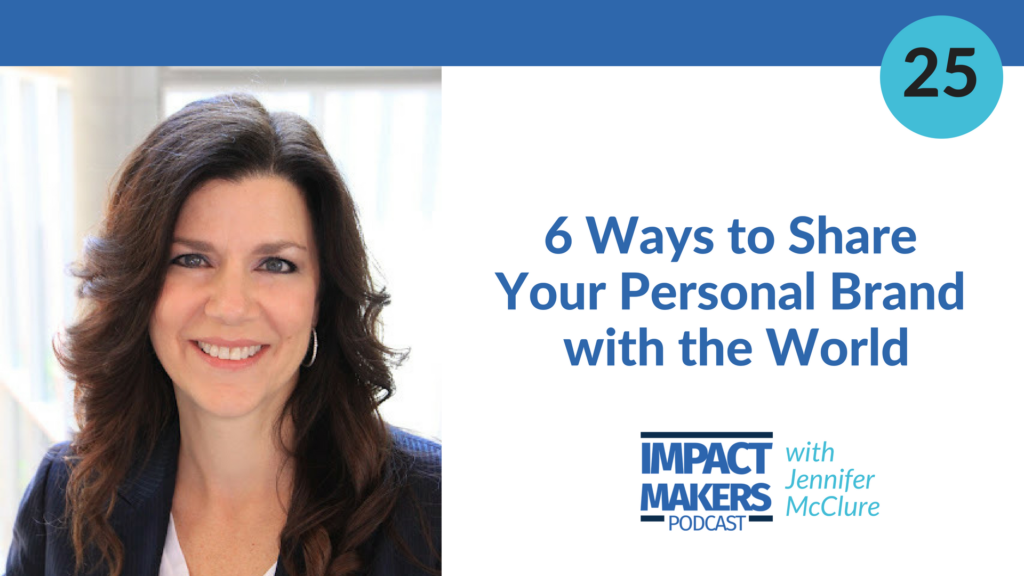
6 Ways to Share Your Personal Brand with the World

Communicating your personal brand doesn’t have to be complicated. Your next step is often right under your nose! This episode concludes Jennifer’s three part series on personal branding, and she shares 6 ways that you can do to begin sharing your personal brand and how to get the opportunities that you’re looking for.

  • Over the last three weeks, Jennifer and her guests have dissected what a personal brand is, how you can define it, as well as how you can continue to develop your brand throughout your career and your life.
  • Although your personal brand is always evolving, there are guidelines that will help in effectively communicating who you are, who you help, the solution/s you deliver, and how it impacts the people involved.
  • Your personal brand helps people determine whether you’re a good fit for their needs. “Are you authentic enough? Are you expert enough? Are relatable enough?” Your personal brand is what defines you, whether you like it or not, whether you’re aware of it or not – so make it work for you and not against you.

So, what can you do to get your personal brand out into the world? Here are 6 Action Steps that You Can Take to Share Your Personal Brand with the World:

#1 Online Activity. The internet is one of the best ways to build your reputation, so it’s your responsibility to take charge of your online activity and understand the importance of having and keeping a positive online presence.Fact: Information about you that’s found online is used by others to assess your credibility, knowledge, and experience.

  • In the book, Career Distinction by William Arruda & Kirsten Dixon, they suggest that you do a Google search of yourself and answer an online distinction survey to help you assess your current online identity.
  • Jennifer notes that a great way to boost your online presence to your favor is by creating a 100% complete account on LinkedIn, pay attention to that platform, and find ways to be active.
  • If I search for you online, I should see your personal brand statement right away and examples of how you’re growing in your career, volunteer activities, or just some way I get a positive first impression about you enough to take the first step: hire, recruit, collaborate, etc.

#2 Share your expertise through writing and curating content. Writing allows you to spread your knowledge that can help people and make an impact in their lives. Share your thoughts unique to you, write about what you do, what you think about the future, what you think is going on with the world now.

  • If you don’t want to create a website or start your own blog, then offer to write for or curate other thought leaders’ content.

#3 Helping others by mentoring and coaching. Helping other people actually helps you! Being THE helpful expert, builds your online presence as someone who is knowledgeable enough and sought out enough that makes people want to follow you.

  • Great coaches, great mentors, are GREAT LISTENERS. People who ask, “Tell me what’s going on in your world, how do you feel about that, what do you think you should do next?” They listen, ask, and then give advice — more often than not, they help the person work through the problem themselves.

#4 Being active on at least one social media platform to share your expertise. “If content is the fuel for your personal brand, then social media is the engine.” – Jason DeMers, AudienceBloom CEO

  • Create things that go up higher on search results, something that social media platforms can help you achieve. Choose one social media platform that you’re going to invest your time and effort on. Post thoughts, connect and interact to build meaningful relationships – use that site to its best advantage. You can join all the social media channels IF you have the capacity to, but at minimum start with one.

#5 Speak, moderate, and be a panelist. Not everyone needs or want to be a speaker, but even if you don’t want to stand up and be the keynote speaker with a thousand people in the room, you can be on a panel and share your expertise. Challenge yourself to stand up and share your expertise, just being a speaker at an event, elevates their perception of your credibility as a leader.

#6 Volunteer: Help organizations, help places you support, help connect people. There’s a reason why business executives, gurus, and other thought leaders commit to volunteering efforts. Aside from the obvious positive impact it has on your image, it’s effective in building solid relationships as well as getting things done. Being a leader who volunteers is a win-win-win situation for the cause you support, your connections, and your personal brand.

The most powerful word in branding is, “THE.” When people say you are, “THE something,” then your personal brand is working for you. If you want your personal brand to continue working for you, then you have to define it, develop it and have it communicate WHO YOU ARE and WHAT YOU STAND FOR.

Want a little help creating your personal brand?

Jennifer has a free resource for you. The Personal Brand Workbook will help you figure out what your personal brand is today and what you want to be known for in the future, as well as how you want to impact the world. Download it today!

Resources & Links:

Impact Makers Episode 23

Impact Makers Episode 24

Impact Makers Episode 5

Let’s Fix Work with Laurie Ruettimann Episode 24

Career Distinction by William Arruda & Kirsten Dixson

Jason DeMers


Some of the links in the post above are “affiliate links.” This means if you click on the link and purchase the item, I will receive an affiliate commission. Regardless, I only recommend products or services I use personally and believe will add value to my readers. I am disclosing this in accordance with the Federal Trade Commission’s 16 CFR, Part 255: “Guides Concerning the Use of Endorsements and Testimonials in Advertising.”

Categories: Blog, Podcast
Posted on August 23, 2018

Written by Jennifer McClure

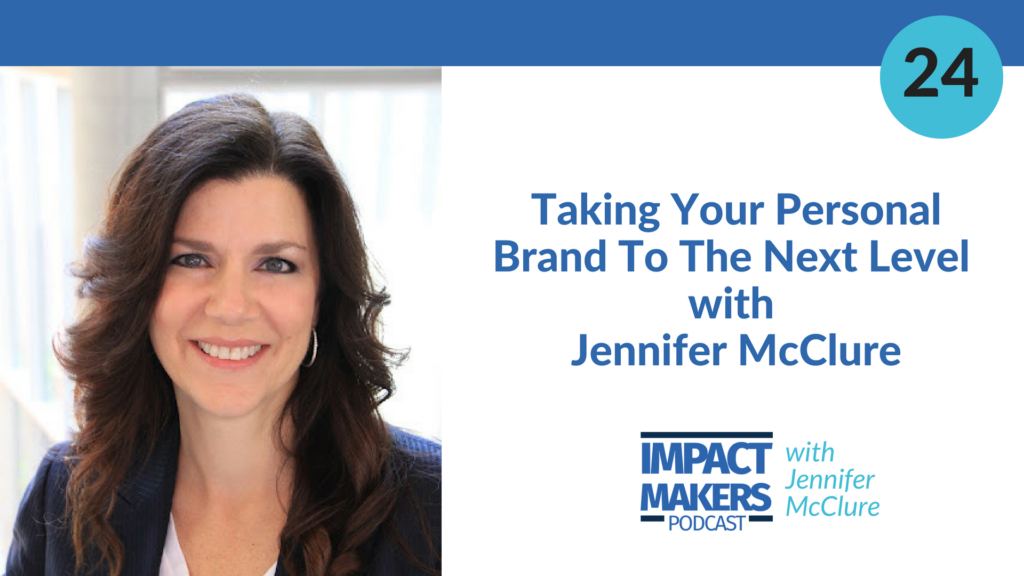
Taking Your Personal Brand to the Next Level with Jennifer McClure

In the words of Sally Hogshead, “Different is better than better.” In the second part of a 3-part series on personal branding, Jennifer shares some tools, strategies and exercises from her Personal Brand Worksheet that you can use to discover where you’re at and help to get to where you want to be. In next week’s episode, we’ll be taking what you’ll learn today out in the world.

  • In today’s episode, Jennifer will talk through some of the steps of her Personal Brand Worksheet. This week’s episode is the second part of a 3-part series on personal branding. If you missed last week’s episode, please listen here before continuing with episode 24!
  • What is a personal brand? Jennifer defines the personal brand as “the perception that people have of you compared to others in similar positions”. So in order to secure those opportunities that you want, you’ll have to stand out from a crowd in a big way.
  • So where does one start? One of the best personal brand assessments that Jennifer has found was created by Sally Hogshead. You can find it in her book called Fascinate: How to Make Your Brand Impossible to Resist or online at com
  • Today’s world is noisier than ever and career success no longer hinges on securing a quality job. To really move up, get noticed by the right people at the right time is the name of the game. But how can you stand out when everyone else trying to do the same thing at the same time on the same platforms?
  • You might be happy with your job today but if the 2008 recession has taught us anything, it’s that ironclad job security is a thing of the past. Rather than focusing on employment security, the new reality of work is all about employability. And that’s where your personal branding comes in.
  • Do you have Jennifer’s Personal Branding Worksheet in front of you? Let’s get started! Feel free to pause the podcast and take your time on each section.
  • Forget your job title. Don’t let it pigeonhole you when you’re looking to make an impression. Instead, consider: how does what you do add value? What are you most proud of? And what gets you excited? These are things that will help you stand out.
  • Identify your skills and strengths. What do you bring to the table? What comes naturally to you? Narrow these down to 3 to 5 thing that you truly excel at. You can use the words on the worksheet for inspiration!
  • Let’s take a look at the bigger picture. How people view you is an integral part of your personal brand. Think about how your colleagues or friends would describe you.
  • What do you aspire to be? How do you want to make an impact in this world?
  • We all have a personal brand whether we want to or not. So now it’s time for the hard part: ask the people around you about their perception of you to find out what your existing brand looks like. What three words would they use to describe you?
  • Take these words and type them up into a document. No skipping allowed! Upload them to net to create a word map and find the words most commonly used to describe you. This can help you identify what people do – and don’t – associate with you, and help you figure what you need to do to get the words you want to show up on your map.
  • So you’ve taken stock of where you are but where do you want to go? One exercise that can help you shape your personal brand is creating a Personal Branding Statement.
  • Jennifer uses the BRAND acronym to break down this exercise. B for bold, R for relevant, A for authentic, N for notable, and D for differentiated. Jennifer also talks about some notable personal branding statements she’s come across and why they stood out to her.
  • Ready for some homework? Start thinking about your own personal brand statement. Jennifer suggests using Kary Oberbrunner’s formula to develop your statement. Fill in the blanks!
    • I am (your professional identity) who helps (your audience) do or understand (your unique solution) so that (transformation/benefit).
  • Share your personal brand statement with us! You can send Jennifer an email or LinkedIn message or share it on social media with the hashtag #impactmakerspodcast.


Resources & Links:

Personal Brand Worksheet

Impact Makers Episode 30 – Your Personal Brand

Sally Hogshead

Fascinate: How to Make Your Brand Impossible to Resist

Howtofascinate.com

Impact Makers Episode 4 – Quit the Cubicle with Mike Kim

Meg Guiseppi

Impact Makers Episode 7 – How I Became A Speaker And Entrepreneur


Check out another trailblazing HR powerhouse!

HR expert Laurie Ruettiman hosts a podcast called Let’s Fix Work where she speaks with a diverse array of people about how to change the way we think and work for the better.

Give us a hand getting the word out!

Do you want to spend your personal and professional time making a lasting impact on others? Do you want to be the kind of leader people love? Subscribe today and we will bring you new ways to change the world every single week.

Categories: Podcast
Posted on August 16, 2018

  • « Previous Page
  • 1
  • …
  • 17
  • 18
  • 19
  • 20
  • 21
  • …
  • 57
  • Next Page »

Recent Posts

  • Why HR Should Be the Chief Disruption Officer in Every Organization
  • Mastering the Art of Virtual Networking: 5 Steps to Build Powerful Connections Online
  • Networking for Introverts: Practical Strategies for Building Meaningful Connections with Greg Roche
  • Leading with Vulnerability: The Key to Future-Ready Leadership with Jacob Morgan
  • Future Fluidity and the Evolving Role of Leadership in the Age of Disruption With Dr. Tanvi Gautam

Categories

Archives

Need A Speaker?

I've delivered keynotes and led workshops at over 350 conferences and corporate events.

If you want to check my availability for your event, or if you have questions, click below.

Start the Conversation »

Recent Blog Posts

  • Why HR Should Be the Chief Disruption Officer in Every Organization
  • Mastering the Art of Virtual Networking: 5 Steps to Build Powerful Connections Online
  • Networking for Introverts: Practical Strategies for Building Meaningful Connections with Greg Roche
  • Leading with Vulnerability: The Key to Future-Ready Leadership with Jacob Morgan
  • Future Fluidity and the Evolving Role of Leadership in the Age of Disruption With Dr. Tanvi Gautam

Connect on Social

  • Facebook
  • Instagram
  • LinkedIn
  • Twitter
  • Vimeo

Copyright © 2026 · Jennifer McClure · Privacy Policy

Copyright © 2026 · McClure Pro on Genesis Framework · WordPress · Log in