Jennifer McClure`

Equipping people leaders to navigate change — and design the future — with boldness and purpose.

  • About
  • Speaking
  • Schedule
  • Blog
  • Impact Makers Podcast
  • Contact

Written by Jennifer McClure

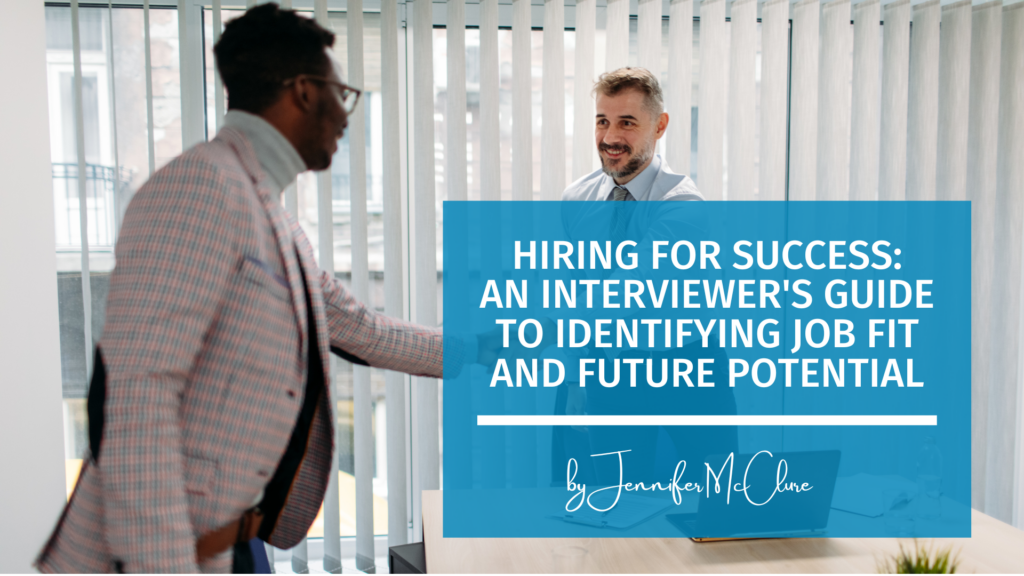
Hiring for Success: An Interviewer’s Guide to Identifying Job Fit and Future Potential

Recently, for a student research project, I was asked to provide my thoughts on the skills that I believe are essential for young professionals entering the workforce, as well as how I would assess these skills in internal or external job applicants.

Below are the questions that were asked of me, as well as my responses.

Question 1: What specific knowledge, skills, and abilities do you look for in new applicants?

Generally, I look for curiosity, communication skills, problem-solving ability, and a desire to learn and grow. If an applicant has these skills and abilities, then they can be developed, and can grow into a variety of roles over time.

Specifically, I would also look for basic qualifications and experience to do the specific job that they’re applying for. Unless it’s a truly entry level position, ideally, they will have some education, volunteer experience, or work experience related to the job that they can demonstrate through results they’ve previously been able to achieve.

When interviewing, I’m always interested in hearing from applicants how they improved something in a previous or current role, and how they approached specific challenges or assignments. I want to be able to understand how they’re oriented towards solving problems, taking on challenges, and pushing through resistance.

Question 2: Which of these knowledge, skills, and abilities do you think are the most important for candidates to have, in order to advance in their career?

I place a priority on a candidate’s desire to learn and grow, and curiosity to seek out opportunities or problems/challenges that need to be solved in order for the company to successfully achieve its goals.

I want to understand if they’re intellectually curious enough to ask great questions in order to understand the current state/desired state? Also, do they seek out growth opportunities?

Question 3: What factors are considered more heavily in the hiring process – previous experiences, qualifications, or an applicant’s performance during the interview?

The answer to that question will depend upon the position level that I’m hiring for.

For entry level positions, I would focus more on the interview, education and qualifications, but as mentioned above, I’d be looking more for learning ability, curiosity, and growth orientation.

For mid-level or senior roles, previous work experience is going to weigh more heavily, but I would also be looking for the same things that I do with entry-level folks. However, I’d be asking candidates to share specific examples of how they’ve demonstrated the skills required in the job in one or more of their previous roles or life experiences.

Question 4: How does utilizing past experiences and examples from their work history help candidates to address difficult interview questions and demonstrate qualifications for a role?

I believe that it’s critical for interviewees to have some examples prepared in advance to show how they’ve demonstrated specific skills or abilities in their past jobs, education, or volunteer experiences, as well as how they have gotten results. A Career Coach I worked with once called these CAR (Challenge / Action/ Result) stories, and I’ve also heard them called STAR (Situation / Task / Action / Result) stories.

If an applicant prepares several examples from their experience that they can put into one of these frameworks prior to interviews, then they can be utilized to effectively answer many behavioral interview type questions – those “Tell me about a time when…” questions.

As an interviewer, when I ask a behavioral interview question, I’m not necessarily interested in the actual story the person is telling me as a response. I’m looking to understand their thinking process, how they approach challenges or responsibilities, how they respond when things don’t go as planned, how they involve others, etc. If the end result is a win, that’s great, but I think there are also good stories that can be shared where the end result wasn’t what was expected or hoped for, but the applicant can work in what they learned from the “failure”, and how they approached recovering from the failure in order to achieve the desired results.

—

Obviously, a good interview requires much more in-depth discussion and questioning, but in general, for the purpose of this study, I tried to sum up some of the key skills to look for in candidates that I believe make the best hires for not only the current job opening the candidate is being considered for, but also to have the best chance for future growth and success with the company.

___________________________

As a keynote speaker and leadership coach, Jennifer McClure helps leaders to embrace the future of work, and to develop the skills necessary to lead their organizations and the people on their teams to take bold actions that positively impact business results.

Want more leadership and future of work insights from me?

SUBSCRIBE to get my weekly Impact Makers newsletter delivered to your inbox!

Categories: Blog, Interviewing
Posted on August 15, 2023

Written by Jennifer McClure

Hiring for “Cultural Fit” – How Do You Make It Tangible?

Today’s post is a guest post from the folks at Halogen Software.

Why would I turn over this “valuable” real-estate to a vendor in the HR space when I don’t accept advertising on my blog? Because they actually read some posts from my blog and sent me a personal email suggesting several topics that they could contribute a post on within the areas I typically write about – without directly promoting their products. As someone who gets several non-personalized and non-related pitches per day, I found the interaction refreshing – and I’m always interested in reading/learning from other’s perspectives.

So give it up for Sean Conrad and Halogen Software sharing some tips on Hiring for Cultural Fit…

—

When it comes to hiring, it’s easy for recruiters, HR and hiring managers to focus on a candidate’s technical qualifications and skip right over the things that are harder to quantify – like cultural fit.

While corporate culture is somewhat intangible, it’s also a critical asset to your organization, one that needs to be carefully considered as part of the hiring process.

Why? Well, when you consider the costs of a poor hire – with estimates running as high as $300,000 to $500,000 (Dr. John Sullivan) – hiring for cultural fit has a huge impact. Of course every HR professional is looking to find and hire candidates who will excel at what you’ve hired them to do and who will mesh well with their organization’s way of doing things.

Whether it is a culture of innovation, collaboration, world class customer service, etc. hiring for cultural fit means your new hire is likely to be more motivated, interact more easily with other employees, and be happier on the job. All of which translates into a higher performing employee. For these reasons, how well you sustain your organization’s culture by hiring for fit directly impacts competitive advantage, innovation and other key business imperatives.

Last September, in Help Me With My Homework: What Are the Top Issues for Human Resources Today?, Jennifer discussed some of the priorities and focus areas for Human Resources and Human Capital professionals. Specifically: engagement, leadership development and retention. Companies that live their culture are high performing and better places to work, which of course directly impacts the three priorities just mentioned. So how do you attract and retain the right employees to reinforce and sustain your culture?

Make Corporate Culture Tangible

When an organization’s cultural values are clearly defined, they act as a beacon for attracting and retaining the right type of individual – and for building a high performance workforce. Values drive the behavior that is desired or expected of employees at each stage of the employee life cycle: hiring, compensation, orientation, promotion, discipline, training and succession planning and an effective Talent Management process explicitly supports these behaviors by translating values into specific competencies that can be assessed and rewarded at each stage. The key is to make these cultural values tangible and ensure they are considered during the hiring process. Sure, gut feel on a candidate’s fit is important, but anyone making hiring decisions in your organization needs something a little more concrete to go on.

For example, it’s important to consider behavioral competencies that describe how a job or task is to be performed, such as how the person takes initiative, how they communicate and work with others, and how they deal with conflicts or challenges. These behavioral competencies are necessary complements to technical competencies, such as knowledge of specific software programs, the ability to operate a type of machine or presentations skills. When behavioral and technical competencies are aligned, they work together to reinforce corporate culture and values.

How effective competency management helps

Building both behavioral and technical types of competencies into job descriptions and the complete talent management process enables those involved in the hiring process to assess the true measures of cultural fit. The end result is improved quality of hire scores because the competencies that make up the job description reinforce the values of the organization.

To take it one step further, those same competencies used in the creation of the job description should also be consistently reflected in ongoing processes – performance appraisals, multi-rater feedback reviews, development planning and talent assessments – to name a few.

By translating corporate values into specific competencies, corporate culture becomes something tangible by which to measure the effectiveness of all your talent management processes. It increases your organization’s ability to invest in your employees, directly impacts effective leadership development planning and increases employee engagement and retention.

—

Sean Conrad is a Certified Human Capital Strategist and Senior Product Analyst at Halogen Software, one of the leading providers of talent management software. For more of his insights on talent management, read his posts on the Halogen blog.

Categories: Blog, Guest Posts, Recruiting
Posted on September 19, 2011

Recent Posts

  • Why HR Should Be the Chief Disruption Officer in Every Organization
  • Mastering the Art of Virtual Networking: 5 Steps to Build Powerful Connections Online
  • Networking for Introverts: Practical Strategies for Building Meaningful Connections with Greg Roche
  • Leading with Vulnerability: The Key to Future-Ready Leadership with Jacob Morgan
  • Future Fluidity and the Evolving Role of Leadership in the Age of Disruption With Dr. Tanvi Gautam

Categories

Archives

Need A Speaker?

I've delivered keynotes and led workshops at over 350 conferences and corporate events.

If you want to check my availability for your event, or if you have questions, click below.

Start the Conversation »

Recent Blog Posts

  • Why HR Should Be the Chief Disruption Officer in Every Organization
  • Mastering the Art of Virtual Networking: 5 Steps to Build Powerful Connections Online
  • Networking for Introverts: Practical Strategies for Building Meaningful Connections with Greg Roche
  • Leading with Vulnerability: The Key to Future-Ready Leadership with Jacob Morgan
  • Future Fluidity and the Evolving Role of Leadership in the Age of Disruption With Dr. Tanvi Gautam

Connect on Social

  • Facebook
  • Instagram
  • LinkedIn
  • Twitter
  • Vimeo

Copyright © 2026 · Jennifer McClure · Privacy Policy

Copyright © 2026 · McClure Pro on Genesis Framework · WordPress · Log in